By: Ranier Simons, ADAP Blog Guest Contributor
Harm reduction is defined as “a set of practical strategies and ideas aimed at reducing negative consequences associated with drug use.”[1] Adverse outcomes of drug use include the spread of transmissible infectious diseases, such as HIV and Hepatitis C, as well as overdose, injury, and death. Effective harm reduction is compassionate and meets people where they are in their journey of drug use.[2] Evidence-based harm reduction does not require the populations being served to stop their drug use.[1] The goal is to enable them to deal with their addiction safely, work towards reducing their drug dependence, and educate and guide users into treatment options as they desire.
 |
| Photo Source: New Hampshire Harm Reduction Coalition |
Removing barriers to tools and assistance is an integral part of harm reduction. Organizations engaged in harm reduction are community-based, engaging directly with people who use illicit drugs. Harm reduction tools include needle exchange programs, safer-sex kits, home testing kits for viral hepatitis and HIV, substance testing kits such as fentanyl test strips, and even naloxone kits to prevent drug overdose.[2] The population in direst need of harm reduction services does not frequent traditional healthcare centers. When available in the community, harm-reduction organizations usually have limited hours and are poorly funded.
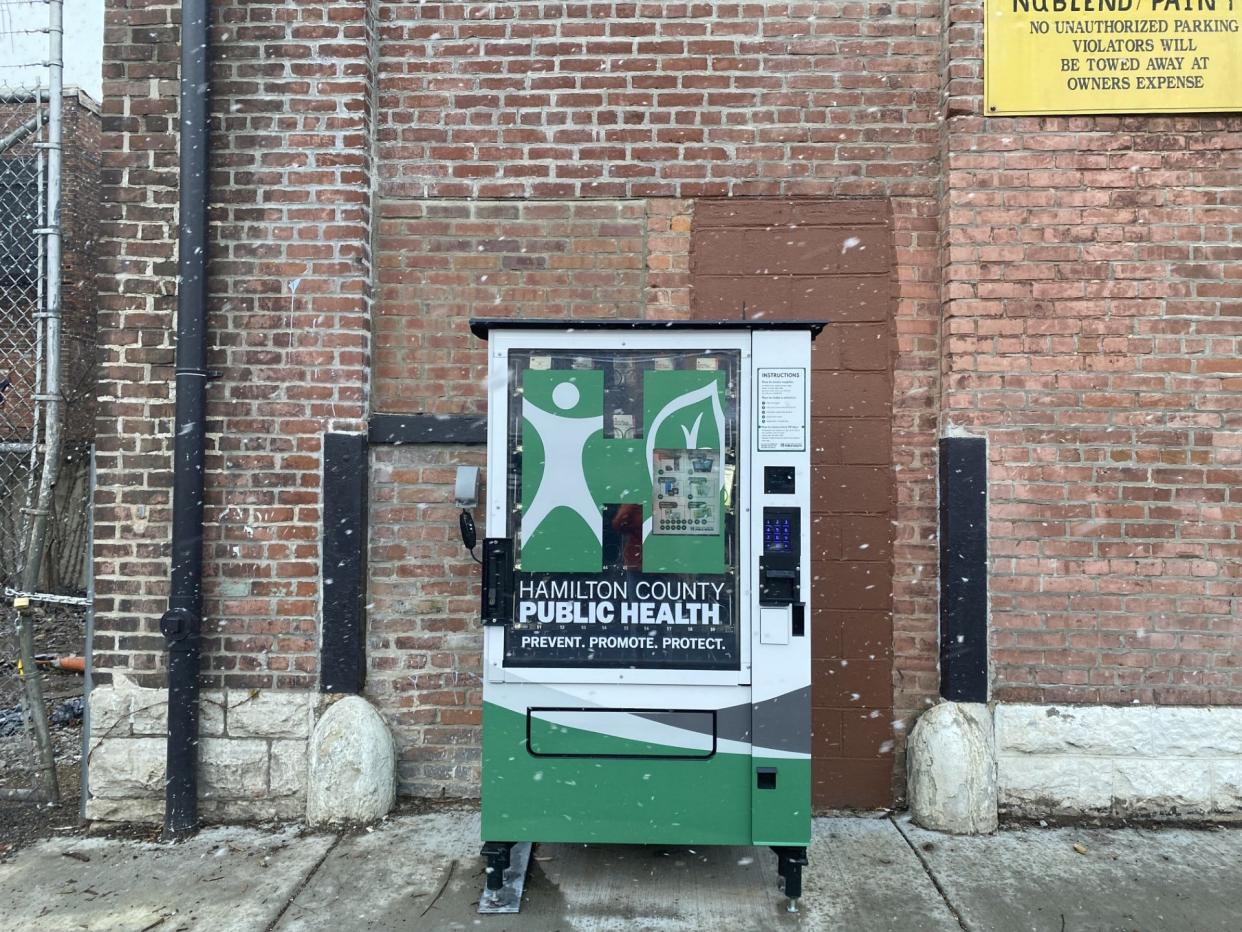
One innovative way to effectively lower the barrier to access harm reduction services is neighborhood vending machines. In December of 2023, in Cincinnati, Ohio, the Hamilton County Health Department installed two life-saving harm reduction vending machines on the streets where people need them.[3] One is located at a downtown Fire Station, and another is located in an alley near a NeighborHub Integrated Health Clinic. NeighborHub Health is a Federally Qualified Health Center (FQHC) exclusively focused on providing integrated medical and behavioral care to those who are homeless and/or living with HIV/AIDS.
These vending machines contain naloxone spray, fentanyl test strips, and condoms. Naloxone spray is used to treat suspected opioid overdoses. Fentanyl test strips empower substance abusers to know if the drugs they are using contain the deadly drug fentanyl in order to prevent death and overdoses. They are small strips of paper that can detect fentanyl in many different kinds and forms of drugs, whether they are injectable, powder, or pills.[4] Condoms are provided to prevent the spread of HIV and other infectious diseases. Substance abuse has been shown to result in people engaging in riskier sexual behavior. Thus, providing condoms along with harm-reduction supplies is a means of accessible, holistic public health intervention.
 |
| Photo Source: Yahoo News |
These two vending machines are additions to Ohio's first harm reduction machine, which was installed in Northside, a community in Cincinnati, in 2021. Caracole, a nonprofit HIV/AIDS organization in Cincinnati, operates and placed the machine outside of its office. This machine contains injection kits for safer drug injections, kits for safer substance smoking, safe sex kits, pregnancy tests, naloxone, bandages, and even containers with which to carry needles and syringes until they can be safely disposed of.[5]
Vending machines are examples of no-contact harm reduction. The vending machines are accessible 24/7 and do not require face-to-face contact. The supplies are free and are accessible via a code obtained by calling a special confidential number, which connects to a trained person who obtains non-identifying information and gives a code. Having on-contact harm reduction resources available on the street with 24/7 access increases accessibility. Some of those in need are uncomfortable with going into centers that may have the supplies or may be unable to get to them during hours of operation. Additionally, no-contact accessibility means that people can get what they need at all hours without judgment or fear of arrest such as sex workers and transient unhoused dealing with substance abuse.
A study published in the Journal of the American Pharmacists Association proved that the Caracole vending machine resulted in increased accessibility of harm reduction products and services and was associated with a lower countywide incidence of unintentional overdose death and HIV.[6] This is important to note since harm-reduction efforts in Hamilton County started in 2014 in response to increased HIV cases. In 2014, the Cincinnati Exchange Project dispensed sterile syringes to drug users to protect them from HIV and Hepatitis C. Vending machines are a practical addition to harm reduction strategies already in use, such as mobile health vans that travel to neighborhoods also providing safer drug use supplies, safe-sex supplies and information concerning healthcare services and treatment.
Harm reduction, in its various forms, is drug overdose and injury prevention, as well as HIV and infectious disease prevention. It should be supported in public policy to innovate and increase funding for modalities already in place, to educate the public and health professionals who sometimes demonize harm reduction efforts due to misinformation, and for research to create new pathways. Harm reduction acknowledges the dignity and humanity of those in need, improves public health outcomes, and can supportively lead people into substance abuse treatment and cessation.
[1] Sue, K., & Fiellin, D. A. (2021). Bringing Harm Reduction into Health Policy — Combating the Overdose Crisis. The New England Journal of Medicine, 384(19), 1781–1783. https://doi.org/10.1056/nejmp2103274
[2] SAMHSA.(2023). Harm Reduction. Retrieved from https://www.samhsa.gov/find-help/harm-reduction
[3] DeMio, T., Kim, R. (2024, January 3). Drugs, sex and harm reduction: New vending machines could reduce spread of HIV. Retrieved from https://news.yahoo.com/drugs-sex-harm-reduction-vending-033416611.html
[4] CDC. (2022, September 30). Fentanyl Test Strips: A Harm Reduction Strategy. Retrieved from https://www.cdc.gov/stopoverdose/fentanyl/fentanyl-test-strips.html
[5] DeMio, T. (2021, March 8). Ohio's first harm reduction vending machine helps promote safer sex, safer smoking, safer injection. Retrieved from https://www.cincinnati.com/story/news/2021/03/08/vending-machine-safer-sex-drug-use-supplies-overdose-hiv-prevention-ohio/4592675001/
[6] Arendt, D. (2023). Expanding the accessibility of harm reduction services in the United States: Measuring the impact of an automated harm reduction dispensing machine. Journal of the American Pharmacists Association, 63(1), 309–316. https://doi.org/10.1016/j.japh.2022.10.027


