Showing posts with label Trump Administration. Show all posts

Thursday, November 19, 2020

How Drug Imports Can Endanger Patients

By: Brandon M. Macsata, CEO, ADAP Advocacy Association

I was diagnosed with HIV just shy of my 30th birthday. That day, everything changed. I was apprehensive about my prognosis, my treatment plan, and my ability to live a normal life.

Brandon M. Macsata, 2001
That was me in 2001 (pre-Dx)

Fortunately, medical advances have turned HIV from a certain death sentence into a manageable condition. Still, like all Americans who depend on complex medications to stay healthy, I worry about high drug prices, and this concern has only intensified amid the COVID-19 pandemic. Especially since some of the proposed "solutions" to high drug prices would put patients' health at risk.

Just recently, the Trump administration announced that it would allow states to import prescription medications from Canada with the aim of saving money for consumers. Doing so, though, could expose millions of Americans to counterfeit drugs, while achieving little in the way of savings.

I've seen firsthand how importation schemes can put patients at risk.

Shortly after learning I was HIV-positive, I ordered my anti-retroviral drugs from an online Canadian pharmacy. For two months, I received medications via mail without ever wondering where they were sourced or whether they contained the active ingredients I needed to keep me alive.

Then my doctor intervened. She told me that drugs purchased through online storefronts are often adulterated or counterfeit—in fact, the global trade in fake medicines is a $30 billion-a-year business. Unknowingly, I had been rolling the dice with my health.

There are two types of counterfeit drugs. The first contains potentially deadly substances—everything from arsenic to antifreeze. The second contains few, if any, active ingredients. Though pills in the latter category don’t contain actual poisons, they can be just as deadly.  Anti-retroviral drugs have to be taken exactly as prescribed; missing even a few doses can allow the virus to reemerge.

There is no mechanism in place to regulate the quality of drugs imported by American patients. A senior official at Health Canada explicitly told the US surgeon general that her agency "does not assure that products being sold to U.S. citizens are safe, effective, and of high quality." The FDA, meanwhile, plainly states that it "cannot ensure the safety and effectiveness of drugs that it has not approved."

Canadian Drugs
Photo Source: PolicyMed.com

Moreover, drugs purportedly from Canada could come from anywhere. A 2017 study by the National Association of Boards of Pharmacy found that three-quarters of online pharmacies claiming to sell Canadian drugs actually sourced their products from places like India, Singapore, and Hong Kong, all major suppliers of counterfeits. Back in 2005, the FDA reported that only 15% of imported drugs marketed as Canadian actually originated in Canada. The other 85% came from "27 countries around the globe," meaning that many likely didn't go through rigorous quality control.

It's relatively easy to get hoodwinked by online pharmacies that promise quality drugs at bargain prices. CanadaDrugs.com, for instance, started out in 2001 as a seemingly reputable online pharmacy. But soon it turned to distributors outside of Canada to secure medicines. In 2018, a U.S. court prosecuted and fined the company for selling fake cancer drugs to American doctors.

Counterfeiters have shown they are willing to prey on people living with all kinds of diseases, including HIV. In 2011, a British regulatory agency discovered that two fake HIV medications had infiltrated the market and were circulating among patients.

Opening the door to drug imports would allow that kind of thing to happen here, putting us all at risk. And it's not even certain that legalizing importation would cut costs. The FDA acknowledges that it is "unable to estimate the cost savings" from President Trump's new plan. Former FDA Commissioner Scott Gottlieb wrote that "when importation of foreign drugs is done under a regulated scheme, it really wouldn't save money."

Right now, Americans are anxious enough about our health. Let's not add drug imports to our list of things to worry about.

This opinion piece was also published in the November 1st edition of the International Business Times.

Disclaimer: Guest blogs do not necessarily reflect the views of the ADAP Advocacy Association, but rather they provide a neutral platform whereby the author serves to promote open, honest discussion about public health-related issues and updates.

Thursday, April 23, 2020

Despite Coronavirus, Trump Administration Proposes 15 Percent Cut To HOPWA Funding

By: Marcus J. Hopkins, Policy Consultant & Guest Contributor 

UPDATE: This piece was authored prior to the passage of the Coronavirus Aid, Relief, and Economic Security (CARES) Act, on March 30th, 2020. This Act included $65 million in additional funding for the HOPWA program. As a result of these additional funds, the “$80 million” cut to the HOPWA program proposed by the Trump Administration will be temporarily abated (assuming that the proposed cut makes it into the annual budget bill).

It should be noted that this $65m is a one-time infusion of funds included only in the CARES Act, and is unlikely to be a permanent fixture in future budgets. The Trump Administration is still proposing the $85m cut to the overall budget.

There are currently efforts underway by HIV advocates and activists to include an additional $65 million in funds in the forthcoming fourth stimulus bill related to COVID-19.

The Trump Administration is, once again, demonstrating its attempt to end social safety nets via deaths by 1,000 cuts. In its latest budget proposal, the Trump Administration is proposing $8.6 billion in funding cuts for the HUD (Housing and Urban Development) program, including $80 million cut from the Housing Opportunities for People With AIDS (HOPWA).

President Donald J. Trump
Photo Source: New York Magazine

HOPWA was created in the AIDS Housing Opportunities Act, as part of the Cranston-Gonzales National Affordable Housing Act of 1990, and has consistently been one of the best-intentioned, but worst funded, managed, and disbursed elements of the various HIV-specific social safety net programs. Plagued by mismanagement at both the federal and state levels, in no small part because of the way the program is administered.

Unlike the overall Ryan White Program, which applies to virtually anyone in a state living with HIV, so long as they meet income verification and upper limit requirements, the HOPWA program operates through the HUD program via a series of grants and relies upon the availability of Section 8 low-income housing.

For example, when I lived in Los Angeles and was in need of a new housing situation when I was separating from my partner, I attempted to sign up for HOPWA via my Ryan White caseworker, only to find that there was, at the time, a waiting list of several years in order to qualify for a Section 8 voucher. What this meant was that, in effect, there were no available Section 8-eligible units available, and I would have to enter my name on a wait list. Should a unit become available, a call would go out, and whomever got there first and qualified was the lucky recipient of a place to live.

This is just on the front-end of HOPWA, however; on the back-end, where the program is administered by state and local governments, inefficiencies, personal and local politics, and failures to may payments to programs on time have created huge issues for people whose housing depends upon the program. There are few places where this is truer than Atlanta, GA:

The City of Atlanta failed to spend $41 million since 2014 meant for the HOPWA program in a dispute involving unpaid contractors, unspent development funds, and a multi-year failure to properly allocate and disburse funds. As a result, in the summer of 2019, hundreds of People Living with HIV/AIDS (PLWHA) were facing eviction as Living Room, the non-profit contractor with whom the City of Atlanta had contracted with to connect PLWHA with low incomes to safe, affordable housing, declared bankruptcy and closed.

Living Room announced in June 2019 that it was unable to pay the rents for roughly 250 clients because the City of Atlanta was several months late in disbursing $500,000 in reimbursement funds for expenses. As a result, those clients’ landlords filed for eviction, resulting in the Atlanta Legal Aid Society being swamped with requests for assistance to the point where they set up a special team just to address the issue. The city responded by paying $371,600 (Mariano, 2019), but those funds arrived too late for Living Room to continue operating.

The problems did not, however, originate with the current administration (Mayor Keisha Lance Bottoms); even when she stood for election in 2017, payments from the City of Atlanta to nonprofit contractors ran so late that many had to borrow against lines of credit and stop taking on new clients (Mariano). Bottoms, who vowed to get to the bottom (as it were) of why these programs were shutting down due to unpaid reimbursement requests has largely failed to live up to the promises she’s made over the past three years, in no small part because her administration has fundamentally failed to properly propose, explain, and implement changes in a timely manner, or to satisfaction of HUD, which has repeatedly expressed public concerns about the administration of Atlanta’s HUD grant.

The problems also do not stop in Atlanta. The HOPWA program has consistently been underfunded and unable to address the needs of PLWHA. The original language in the program focused primarily on people living in urban areas, but changes began, in 2015, to address the needs of PLWHA living in suburban and rural areas. Unfortunately, none of those changes have effectively increased the amount of funding needed, nor increased the availability of housing units.

Where other countries address low-income housing by building government-owned/operated council flats or apartment buildings, the U.S. has stubbornly (and stupidly, in my opinion) insisted upon “public/private partnerships” to address Section 8 housing, relying upon individual property companies and landlords to supply housing and qualify for/accept Section 8 vouchers. This is, no doubt, an artifact of the “Socialism Scare” of the 1950s and beyond, where any sort of social safety net or housing program was deemed “Creeping Socialism” that would doom the U.S. to become a Communist hellhole with never ending breadlines and (shudder) paying to support the Poors.

Housing Is Healthcare

This decades-long failure on the part of federal and state governments to purchase land and build public housing sufficient to meet the needs of lower-income individuals and families (because, why that just wouldn’t generate a profit, you Pinko Commie bastard!) has resulted in an affordable housing crunch exacerbated by municipalities’ [stupid] desire to approve and build only “luxury” housing units that are, in actuality, little different from the medium-range housing units that were built in the late-90s and early-00s, but have the word “luxury” slapped on the development so that they can increase property values and rents.

In rural states, HOPWA funds are largely allocated in the more densely populated regions, where housing is already overpriced and affordable housing is unavailable. This means that people who could find housing outside of these areas are unable to do so, because the HUD grant for HOPWA only covers people if they live inside of those areas…where housing is over-priced and unavailable, creating waiting lists, backlogs, and people struggling to figure where to live and work, all while attempting to manage their HIV and achieve and maintain viral suppression.

In short, even before the proposed budget cuts for HOPWA (for the second consecutive year), HOPWA is a mess of an operation that is in desperate need of nationalization, centralization, and a massive increase in funds to continue to exist.

Disclaimer: Guest blogs do not necessarily reflect the views of the ADAP Advocacy Association, but rather they provide a neutral platform whereby the author serves to promote open, honest discussion about public health-related issues and updates.

Thursday, March 21, 2019

Where the Rubbers Meet the Road on "Ending the HIV Epidemic: A Plan for America"

By: Marcus J. Hopkins, Policy Consultant

In his 2019 State of the Union Address, Donald Trump asked for a bipartisan committee to end the HIV epidemic in the United States within 10 years. Those of us who work in HIV activism and advocacy were (and still are) incredulous, given the Trump Administration’s penchant for undermining virtually every public health initiative.

President Trump outlines a plan to 'eliminate' HIV in the US by 2030
Photo Source: Business Insider

A mere five months prior to his announcement, the Trump Administration (TA) put the kibosh on HIV cure research because it used fetal tissue donated by women who have legal abortion in an effort to appease faux religious liberty activists (Wadman, 2018).

Also, in 2018, the TA released plans to take $3.8 million from HIV/AIDS programs and $5.8 million from the Ryan White HIV/AIDS Program (Kopan, 2018).

Before that, Trump “fired” the reaming members of the Presidential HIV/AIDS Council (formed in 1995 by President Bill Clinton) after six members quit the council in June 2017 in response to TA’s removal of the Office of National AIDS Policy website and Trump’s failure to appoint anyone to lead the White House Office of National AIDS Policy (Thomsen, 2017).

The announcement by Trump that his administration suddenly cares about ending HIV/AIDS came as a surprise to virtually everyone amid continually piling evidence to the contrary. There has been little evidence to support the idea that the TA is concerned with much of anything other than furthering initiatives that, in virtually every other administration, would have resulted in immediate reprisal from Congress.

So, what, really, is the TA’s grand plan to elimination HIV/AIDS by 2030? Health and Human Services (HHS) Secretary, Alex Azar, revealed their proposal, “Ending the HIV Epidemic: A Plan for America,” on February 7th, 2019 (HHS, 2019):

The plan has two primary goals: 1.) Reduce new HIV infections by 75% within five years; 2.) Reduce new HIV infections by 90% within ten years.

These goals will purportedly be reached using three major areas of action: 1.) Increasing investments in geographic hotspots through our existing, effective programs, such as the Ryan White HIV/AIDS Program, as well as a new program through community health centers that will provide medicine to protect persons at highest risk from getting HIV; 2.) Using data to identify where HIV is spreading most rapidly and guide decision-making to address prevention, care and treatment needs at the local level; 3.) Providing funds for the creation of a local HIV HealthForce in these targeted areas to expand HIV prevention and treatment (HHS).

They plan to focus these efforts on 48 high-burden counties, Washington, DC, San Juan, Puerto Rico, and 7 states with a substantial rural burden. How, you may ask? Well, they have four key strategies: Diagnose, Treat, Protect, and Respond – diagnose early, treat rapidly and effectively, protect uninfected populations, and respond rapidly to detect and respond to emerging HIV clusters to prevent new infections.

If this plan seems overly ambitious, it’s because it is.

Realistically speaking, adequately attacking the HIV/AIDS epidemic in the U.S. with the goal of ending it within 10 years is entirely possible…if we’re willing to pony up the resources required to realize that goal. Facts are facts: ending any epidemic is going to be costly, and the Feeral Fiscal Year (FY) 2019 budget for HIV of $34.8 billion dollars isn’t going to come anywhere near close to achieving this goal.

Why? Two words: “Rural America.”

At the beginning of the AIDS epidemic in the 1980s, people who lived in rural parts of the country felt “safe” from HIV/AIDS, because it “…only affected those big city queers.” This thinking dwelled in a peculiar place in the American psyche that believed that Americans largely remained in one place for their entire lives. And then, the 1950s happened…and the 60s, and 70s. As automobiles because more affordable, more Americans left their hometowns and relocated around the country to seek better opportunities and lives. Younger generations were moving out of the hills and hallows of their youths and into…why, they could just go anywhere! With this freedom of movement came certain costs – namely, the spread of infectious diseases.

Travel has always been the enemy of contagion containment, from the earliest days of commerce and conquest when trader ships brought to Europe the deadliest plagues Earth had to offer. So, too, was the case with HIV/AIDS. The idea that a sexually transmitted disease could be contained to metropolitan areas was a quaint notion. People travel to cities; people often have sex in cities (hell, there’s a whole cable series dedicated to the topic); people come back home and bring with them any STDs/STIs they might have picked up and spread them within their local communities.

What has not consistently been the case is that easy access to travel will mean that services will reach the same rural and/or remote places as those diseases. With America’s for-profit healthcare model, healthcare providers must generate a profit in order to remain open; statistically speaking, it is highly unlikely that those providers are going to opt to open locations in the very small towns where services are most needed, because the demand either doesn’t exist, or the residents can’t afford it.
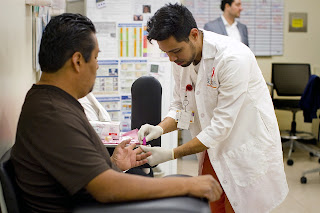
Medical Assistant Hector Reyes administers an HIV blood test to a patient at St. John's Well Child and Family Center on March 18, 2014 in Los Angeles.
Photo Source: Gina Ferazzi / Los Angeles Times via Getty Images file

Geographic barriers to care are an immense problem for a variety of reasons:
  1. Remote parts of the country are not always easily accessible throughout the year – snowfall, flooding, and even seasonal road conditions severely limit both patients’ and providers’ abilities to access and/or provide care;
  2. Telemedicine services are extremely limited in many of these rural areas, because high-speed Internet services and cell phone services are either severely limited or nonexistent – it takes a lot of money to fund expanding high-speed Internet access to rural areas;
  3. Distances to and from healthcare service provision can prove insurmountable for many rural Americans – it’s too costly to travel by vehicle due to gas prices and vehicle maintenance; little to no public transportation exists to take people to and from appointments; a trip to the doctor can consume literally an entire day, which means lost hours at work that cannot easily be recovered.
I know these things because I have personally experienced them. I’ve moved 43 times in my 37 years on this earth and have had HIV services in four different states – Florida, Tennessee, California, and West Virginia. Only in Ft. Lauderdale, FL was it easy for me to get to and from doctor’s appointments without spending entire days. In Tennessee, it took me literally weeks to even find out basic information about the state’s Ryan White program (which did not, in 2008, have a website). In California, though I lived in Long Beach, the nearest location where I could be treated was in Torrance, CA – a mere 15.1 miles on a map, but an hour or longer drive, each way, to get to and from appointments that would last entire days.

This brings me to my current state – West Virginia. In West Virginia, I luckily live close to one of the two Ryan White HIV/AIDS Program Medical Provider clinics. That’s right – there are only two Ryan White clinics in the state of West Virginia – one in Charleston, and one in Morgantown. By Interstate travel, these two cities are 156 miles apart, meaning that everyone in the middle and on the outskirts of the state – where Interstate travel is not always available or easy to access – may end up spending hours driving to and from appointments.

Another client at the WVU Positive Health Clinic in Morgantown, WV drives two hours each way to get to his doctor’s appointments, each of which can last up to three or four hours. For him, this means up to an eight-hour day solely dedicated to accessing HIV care and treatment, traveling along poorly maintained state routes and country roads. Luckily, he has progress well enough in his treatment to be on six-month visits, but realistically, each of these trips is a hassle. If he is sick, injured, or otherwise unable to travel, that means a missed appointment with a long waiting period before he can be seen, again.

These anecdotal evidences aren’t just true for West Virginia, but for the majority of the country. All around the U.S., patients living with HIV in rural areas spend entire days just going to their HIV doctor. And this is the crux of the problem for not only the Trump Administration, but any future administration: in order to truly eliminate HIV/AIDS in the U.S. by 2030, it’s going to require a massive increase in financial and human resources to tackle reaching rural America.

Part of the TA’s proposal focuses on states that already have high rates of HIV transmission in rural areas – Alabama, Arkansas, Kentucky, Mississippi, Missouri, Oklahoma, and South Carolina. These states do have high burdens of rural transmission, with 10% or more of new infections occurring in rural areas. What the current plan fails to take into account, in my opinion, is the growing risk of infection via Injection Drug Use (IDU).

Trump health chief supports needle exchange programs to prevent new HIV infections among drug users http://hill.cm/hJGrp1Q

IDU is already contributing to high rates of Hepatitis C (HCV) infections in places like West Virginia. In 2015, the rate of new HCV infections was 3.4 (per 100,000); in 2016, that rate increased to 5.1; in 2017, the rate increased, again, to 9.1 (WV Department of Health and Human Resources, 2018). A majority of the Hepatitis B (HBV) and HCV cases in WV reported IDU or street drug use as the primary risk of infection.

It’s not a big leap to assume that, as was the case in Scott County, Indiana, IDU will lead to increased transmission of HIV in state with a high incidence of IDU. This means that there will need to be significant increases in intervention funding in rural states, not just in the small metropolitan cities like Charleston and West Virginia, but in areas that are less easily accessible. Those interventions come neither cheaply, nor without significant public opposition.

Frankly, I don’t believe that the current administration is either willing or able to pony up the kind of cash that will be required to fund the types of interventions needed to achieve their goal. We’re not just talking about reaching rural areas, although that’s the largest roadblock; we’re talking about hiring and training thousands of new personnel, paying for treatment for lower- and middle-income individuals who cannot afford the high price of HIV Anti-Retroviral (ARV) medications, covering transportation costs for both patients and medical personnel, purchasing testing supplies, paying for confirmatory testing and blood work (the latter of which can run into the thousands-of-dollars per patient), hiring, training, and deployment case workers to ensure medication/treatment/physician adherence. The list of things that are going to be required in order to accomplish this goal is so long and so costly, that I doubt it can feasibly be accomplished.

I’m going to be pegged as a naysayer; as a cynic. In realistic terms, what we’ve seen over the past thirty years is that, on average, they type of funding that is necessary to successfully deploy this kind of ambitious plan hasn’t been put on the table for decades. Within the HIV activist/advocacy community, we have been all but terrified to reopen the Ryan White program to reauthorization, out of fear that a Republican legislature will gut the funding down to the bare bones. And honestly, that’s not a fear that is without precedent. Outside of Defense spending, Republicans, on the whole, have been loath to increase funding for anything else without drastic spending cuts elsewhere – a strategy that is both shortsighted and destructive to public health initiatives.

I’ve attended numerous conferences where statements like the following have been made:
“The primary job of big HIV organizations is to ensure that we don’t lose any of the $35 billion dollars in funding that we have.”
This quote (which is a direct quote from an Atlanta area activist/advocate) is terrifying, because it not only indicates that there is fear amongst organizations that those funds will be cut, but that we cannot – and should not – be vocal about our needs. If we make too many waves or too much noise, we risk losing funding. As a result, we cannot be ambitious or innovative in tackling the rural HIV crises we face, because to do so will risk the funds we’re already using to address the underserved needs of people in urban areas.

So, yes – when it comes to the Trump Administration’s grand plans for HIV prevention, I am skeptical that they will succeed. They haven’t even tried to produce enough staff members to work on their own initiatives; what would lead us to think that they would do so to address a problem as widespread as HIV?

References:
  • Health and Human Services. (2019, February 07). What is ‘Ending the HIV Epidemic: A Plan for America’?. Washington, DC: United States Department of Health and Human Services: HIV.gov: Office of HIV/AIDS and Infectious Disease Policy: Federal Response. Retrieved from: https://www.hiv.gov/federal-response/ending-the-hiv-epidemic/overview
  • Kopan, T. (2018, September 20). Trump admin moves $260M from cancer research, HIV/AIDS and other programs to cover custody of immigrant children costs. Atlanta, GA: CNN: Politics. Retrieved from: https://www.cnn.com/2018/09/20/politics/hhs-shifting-money-cancer-aids-immigrant-children/index.html
  • Thomsen, J. (2017, June 17). Six resign from presidential HIV/AIDS council because Trump 'doesn't care'. Washginton DC: The Hill: Healthcare. Retrieved from: https://thehill.com/news-by-subject/healthcare/338296-six-resign-from-presidential-hiv-aids-council-because-trump-doesnt
  • Wadman, M. (2019, December 13). Updated: NIH says cancer study also hit by fetal tissue ban. Science. Washington, DC: American Association for the Advancement of Science: Science: News. Retrieved from: https://www.sciencemag.org/news/2018/12/trump-administration-has-quietly-barred-nih-scientists-acquiring-fetal-tissue
  • West Virginia Department of Health and Human Resources. (2018, July 01). Acute Hepatitis C Incidence Rate, 2007-2017. Charleston, WV: West Virginia Department of Health and Human Resources: Bureau for Public Health. Retrieved from: https://oeps.wv.gov/HCV/documents/data/acute_hcv_chart.pdf

Disclaimer: Guest blogs do not necessarily reflect the views of the ADAP Advocacy Association, but rather they provide a neutral platform whereby the author serves to promote open, honest discussion about public health-related issues and updates.

Friday, October 5, 2018

Did Trump Pull the Plug on ONAP & PACHA?

By: Brandon M. Macsata, CEO, ADAP Advocacy Association

The ADAP Advocacy Association has learned from a highly credible source that the Trump Administration will not fill the vacant director position at the Office of National AIDS Policy (ONAP), nor will appointments be made for the Presidential Advisory Commission on HIV/AIDS (PACHA). These important leadership roles have remained unfilled since President Barack Obama left the White House, or soon thereafter.

Angry looking photo of Donald J. Trump
Photo Source: crooksandliars.com
Earlier this year the ADAP Advocacy Association called for the appointment of an ONAP director after Amy Lansky, ONAP's last-serving director, stepped down. Subsequently, it has been an issue at the center of our advocacy efforts, including a previous ADAP Blog. It should really come as no surprise that the Trump Administration, which has proven itself to not be friendly to the HIV/AIDS community, would leave ONAP vacant. 

Equally troubling is how the Trump Administration solicited nominations for PACHA, only to file them in the trash. It begs the question: Is there no regard for our community’s input into this nation’s public health response to the ongoing epidemic here in the United States?

Thursday, June 8, 2017

Linkages to Care - Housing is Healthcare: Linking Stable Housing & Medication Adherence

By: Brandon M. Macsata, CEO, ADAP Advocacy Association

Find me a physician who treats patients living with HIV/AIDS, and I'm certain the physician stresses medication adherence to anyone who will listen (yes, probably even Dr. Ben Carson). Find me a patient living with HIV/AIDS, and I'm certain the patient notes an equally important message: I cannot worry about my medications unless I have a roof over my head (yes, someone needs to tell Dr. Ben Carson). Intertwined are these two important facts.

The important linkage between housing and healthcare was spelled out last year in a blog by Kathie Hiers, who serves as the President & CEO for AIDS Alabama. In her blog, Housing=Healthcare, Hiers stated the following key points:
According to the National Low Income Housing Coalition’s 2015 Out of Reach Report, not a single state in our nation offers a one-room apartment that a person working full time and making minimum wage can afford. In fact, federal minimum wage has not increased since 2009 while rents have risen in almost all metropolitan areas. For PLWH, the need for housing assistance is far too commonplace. According to the National AIDS Housing Coalition, at any given time about 50% of 1.2 million PLWH in our country experience homelessness or housing instability. Additionally, research indicates that people who are unstably housed or homeless have HIV rates up to 16 times as high as persons in stable housing. Unfortunately the need substantially outstrips the resources. But here’s the bottom line: housing for PLWH improves medical outcomes, reduces new transmissions through a reduction in risky behaviors, and provides cost savings. So much research exists to confirm these results that AIDS and Behavior in 2007 dedicated an entire issue to illustrate the findings.[1]
Unfortunately, there aren't enough affordable, stable housing units available to keep up with demand. The shortage undermines efforts to achieve positive health outcomes in many areas of the country, both in rural and urban areas. Efforts are underway to modernize the federal housing programs designed to help those in need, including the Housing Opportunities for Persons with AIDS (HOPWA). But not all of the "efforts" are necessarily good for the people the programs are designed to assist.

Dr. Ben Carson testifying before Congress
Photo Source: Slate.com

Testifying earlier this week before the U.S. Senate Committee on Appropriations Subcommittee on Transportation, Housing and Urban Development, Dr. Ben Carson, Secretary of the U.S. Department of Housing & Urban Development (HUD), summarized some of these changes to the federal government's housing policy:
"Last year’s changes to the formula for Housing Opportunities for Persons with AIDS (HOPWA) was a great step towards efficiency, shifting funding to areas with higher numbers of HIV/AIDS cases, rather than historical incidents. This is the kind of targeted efficiency that will help us do the most with limited Federal resources. We provide a phased-in approach to the new formula to provide communities time to adjust. The additional funding in 2017 also will help provide communities more time to adjust to the new formula. The 2018 Budget provides $330 million for HOPWA."[2]
Ironically, Secretary Carson failed to mention that the Trump Administration's proposed Fiscal Year 2018 budget calls for a $26 million funding cut from HOPWA and that "these cuts will certainly increase the number of people living with HIV who will not have stable housing."[3] The proposed reduction represents nearly a 7 percent cut in funding.

Concerns have been mounting over the potential impact of funding cuts to housing programs, as well as healthcare programs. David Reiss' Op-Ed earlier this year characterized the proposed budget as "bad news."[4]

Housing is Healthcare
Photo Source: Community Partnership of the Ozarks

In an effort to raise awareness about affordable, stable housing and how it improves medication adherence for people living with HIV/AIDS and/or viral hepatitis, we will host an educational training webinar on June 28, 2017. The webinar, "Housing is Healthcare: Linking Stable Housing & Medication Adherence," will discuss the research that supports housing as a structural intervention that improves health outcomes through improved adherence to treatment. Presenters will share successful housing models where residents have seen this success. It will provide webinar attendees with how to use research to show the direct causation between health outcomes and housing placement, and understand strategies to the connection between medication adherence and stable housing.

Registration is open to all stakeholders. Registration is complimentary for PASWHA members, and it is also complimentary for patients living with HIV/AIDS. Use this scholarship link if you are a patient living with HIV/AIDS applying for a webinar scholarship.

Additional information about the webinar is available online at https://www.123signup.com/event?id=nhjqn.

__________
[1] Hiers, Kathie (2016, May 6); ADA Blog; Housing=Healthcare; ADAP Advocacy Association. Retrieved from http://adapadvocacyassociation.blogspot.com/2016/05/by-kathie-hiers-president-ceo-aids.html.
[2] Carson, M.D., Ben (2017, June 7); Written Testimony on Review of the FY2018 Budget Request
for the U.S. Department of Housing & Urban Development; Committee on Appropriations Subcommittee on Transportation, Housing and Urban Development. Retrieved from https://www.appropriations.senate.gov/imo/media/doc/060717-Carson-Testimony.pdf.
[3] Schmid, Carl (2017, May 23); TRUMP BUDGET: A SETBACK TO HIV AND HEPATITIS ELIMINATION; The AIDS Institute. Retrieved from http://www.theaidsinstitute.org/sites/default/files/attachments/TAI%20FY18%20Budget%20Press%20Release%20FINAL.pdf. 
[4] Reiss, David (2017, March 16); Trump's budget proposal is bad news for housing across the nation; The Hill. Retrieved from http://thehill.com/blogs/pundits-blog/economy-budget/324211-how-trumps-budget-cuts-could-affect-housing-for-thousands.