Showing posts with label PlusInc. Show all posts

Thursday, December 18, 2025

2025: A Look Back on Our Advocacy

By: Brandon M. Macsata, CEO, ADAP Advocacy

ADAP Advocacy inches toward the conclusion of an active year in advocacy, one defined by chaos, perseverance, and targeted success. At the outset of 2025, we issued a call to serve for grassroots patient advocates. The MAGA movement's return to power set the stage for upheaval. Still, very few advocates could have predicted the scope of the damage being done to the nation's public health system, ranging from vaccine skeptics driving misinformation into the mainstream to dangerous price control schemes, or draconian cuts to both prevention and treatment services for people living with HIV/AIDS. ADAP Advocacy was among the first national advocacy organizations to warn that cuts were coming to popular programs, like the Ryan White HIV/AIDS Program, despite the widely accepted belief these programs were "safe" from ideological attacks.

ADAP Advocacy Warns Advocates Potential HIV Funding Cuts Loom

Our contribution to fighting the Trump Administration's dangerous policies was to re-engage our grassroots network, which had last been deployed during the ADAP Crisis in 2008-2012. It's older now, with even more ailments, but still vibrant and committed enough to deliver effective patient advocacy. At no time was it more necessary than when the bombshell hit that HIV prevention funding was being gutted at the Centers for Disease Control & Prevention. When these critical HIV prevention programs faced elimination, ADAP Advocacy, like so many other organizations, stepped up and warned lawmakers about the negative repercussions. These cuts were only exacerbated by the One Big Beautiful Bill Act (OBBBA) and its steep cuts to Medicaid, which our grassroots efforts also opposed. Whereas far too many funding cuts have occurred this year, they have also sparked a renewed call for patient advocates to be more vocal about the policy decisions that could affect them.

There is no greater example of the need for patient advocates to engage than the 340B Drug Pricing Program. In 2025, ADAP Advocacy launched its 'Too Big To Fail?' national advocacy campaign, comprised of blogs, television commercials, fact sheets, policy papers, and op-eds. Our commercial calling out hospitals for aggressive debt collection garnered over half a million views on YouTube, alone. Our op-ed in POZ Magazine, "Why the 340B Rebate Model Puts Patients Before Profits", added the patient perspective to this important policy debate.

Why the 340B Rebate Model Puts Patients Before Profits
Photo Source: POZ Magazine

As long-overdue reforms to the program appear within reach, primarily designed to improve access to care and treatment through better accountability and transparency, special interest groups are turning up the heat. These paternalistic ableist voices are a growing threat to silence patient advocates. Provider groups with executives making hundreds of thousands of dollars in compensation packages, and in some cases, exceeding $1 million, telling patients who cannot afford their copayments what is "best" for them is something even the best Hollywood screenwriter couldn't dream up. Starting this year, we're calling a spade a spade when it comes to this behavior.

One key area of success was on long-acting injectables. Despite more state AIDS Drug Assistance Programs (ADAP) following in the footsteps of their state Medicaid programs and covering Cabenuva on their drug formularies, there remain some holdouts. Until 2025, Texas's HIV Medication Program (THMP) had refused to offer Cabenuva...that is, until Texas advocates mobilized and relentlessly pushed for change. ADAP Advocacy, to the extent it was asked to help, chimed in on several occasions. But it was the local voice that brought about real change for people living with HIV/AIDS in their state. We've long embraced the need for national organizations to lead on federal policy, leaving state and local policy debates to the folks who call them home. National groups "meddling" in state policy affairs are rarely successful.

Texas HIV Advocates at the State Capitol
Photo Source: Prism Health North Texas

Our collaborative work was highlighted with the Partnership for Safe Medicines, combating counterfeit drugs, with PlusInc, about the patient perspective on prior authorization, with the Global Coalition on Aging, safeguarding innovation and access for older adults, or spearheading 37 organizations seeking an HIV carveout from the harmful impacts of the Inflation Reduction Act. We hosted key stakeholders for Health Fireside Chats in Minneapolis, Minnesota, and Atlanta, Georgia. Our three patient advisory committees engaged throughout the year to ensure that the voice of persons living with HIV/AIDS shall always be at the table and the center of the discussion.

As ADAP Advocacy enters 2026, patient-centered advocacy resources and tools will become even more critical, and our organization is eagerly preparing to deliver some new ideas. A look back at our advocacy has to focus on the future, mainly by improving access and addressing affordability. 

Disclaimer: Guest blogs do not necessarily reflect the views of the ADAP Advocacy Association, but rather they provide a neutral platform whereby the author serves to promote open, honest discussion about public health-related issues and updates.

Thursday, August 1, 2024

Facing HIV Health Disparities in Latino Communities

By: Ranier Simons, ADAP Blog Guest Contributor

While overall HIV rates in the United States have been in decline, HIV is still a present and impactful issue. This is especially true for communities that experience a higher impact of HIV-related health disparities. One of these groups is the Latino community. The Latino community is second to the Black community about bearing the HIV burden. Several challenges converge in maintaining HIV’s disproportionate impact on the Latino community, including racism, stigma, language barriers, and access. In recently reported data for 2022 by the Centers for Disease Control & Prevention (CDC) the Latino community was about 18 percent of the U.S. population, but represented 33 percent of new HIV diagnoses.[1]

Latinos and HIV
Photo Source: Baton Rouge AIDS Society

According to PlusInc, which addresses health disparities in the United States, HIV disproportionately impacts Black and Hispanic/Latino Americans (according to 2019 data). PlusInc’s HIV health disparities statement notes:

"While Black and Hispanic/Latino make up just 13.4% and 18.5% of the U.S. population, respectively, Black Americans account for 40.3% and Hispanic/Latino Americans account for 24.7% of the total population of Persons Living with HIV/AIDS (PLWHA). Additionally, this disparity extends to the incidence, with 42% of new HIV diagnoses occurring in Black Americans and 27.8% in Hispanic/Latino Americans. According to the Centers for Disease Control and Prevention (CDC), 26% of new HIV diagnoses were among Black gay and bisexual Men who have Sex with Men (MSM), 23% were among Hispanic/Latino gay and bisexual MSM, and 45% among gay and bisexual MSM under the age of 35."

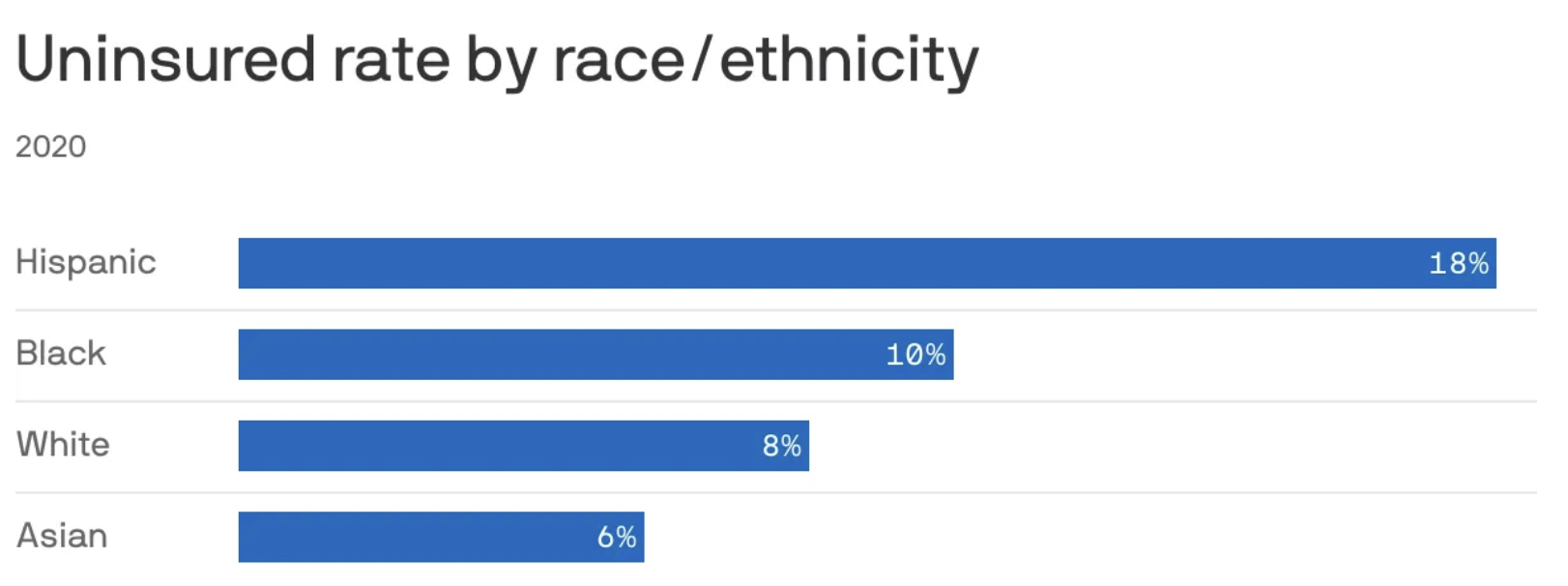
Access is a significant issue contributing to HIV challenges among Latinos. Latinos are the most underinsured/uninsured ethnic group in the United States.[2] Approximately 19 percent did not have health insurance in 2023, in contrast to 5.8 percent of White Americans and 8.6 percent of Black Americans.[3] Lack of health insurance means reduced access to HIV treatment and prevention, reduced or lack of primary healthcare services, or comorbidity management. Only 84 percent of the Latino community is aware of their HIV status, compared to 87 percent of the general population.[4] Of Latinos living with HIV who know their status, in 2021, only 72 percent received some kind of HIV care, 54 percent consistently remained in care, and only 64 percent were virally suppressed.[5]

Many Latinos are underinsured or uninsured due to financial barriers, language barriers, occupation, and even immigration status. In 2022, One-third of Latinos without health insurance were undocumented, and 37.7 percent were dependent upon Medicaid.[6] Some Latinos struggle to understand the healthcare system, and others do not seek out healthcare due to fear of deportation because of their immigration status. In states where they may be eligible for Medicaid, some Latinos in the process of acquiring citizenship are hesitant to apply out of fear of being deemed a public charge. However, only one-tenth of one percent of deportations result from public charge determinations.[6] Moreover, although ACA Medicaid expansion enables more adults to be covered, ten states have not expanded Medicaid, including Texas, Florida, and Georgia, which have large numbers of uninsured Latino residents.[6]

Uninsured rates by race/ethnicity
Photo Source: Axios

Two specific HIV care access challenges affecting the Latino community are PrEP and long-acting injectables. In 2021, Latinos represented 17 percent of PrEP users and 27 percent of new HIV diagnoses.[7] While PrEP could drastically improve outcomes, access barriers are high. Additionally, many Latinos living with HIV could greatly benefit from long-acting injectable treatments, such as Cabenuva, which would ameliorate adherence issues. However, it is expensive, and thus, paying for it out of pocket is impossible. Moreover, getting it covered in public assistance programs is also a challenge.

There are states, such as Texas, that do not carry Cabenuva on their drug formulary under the AIDS Drug Assistance Program (ADAP). Steven Vargas, Texas HIV advocate and long-term survivor, argues, “What I really want is for our Texas ADAP to be brought to its full potential in easing the burden of HIV on Texans.” 

Vargas offers some novel ideas to help Latinos in need, as well as all Texans access Cabenuva. One way would be for Texas to expand Medicaid since Cabenuva is covered by Medicaid. Another option would be to utilize state ADAP funds to purchase insurance for those in need. Unfortunately, presently, in Texas, that is not possible due to exaggerated concerns about costs and solvency. A policy proposal Vargas suggested involves the federal agency, Health Resources & Services Administration (HRSA). He suggests that the agency “...create a policy clarification mandating non-Medicaid expansion states to use ADAP funds to purchase health insurance for HIV-positive individuals. This would ensure more equitable access to healthcare and align with efforts to end the HIV epidemic in these intransigent states. Without such measures, the current inequities will persist, and achieving the goal of ending the HIV epidemic will remain out of reach.”

Stigma is another barrier from a policy, healthcare, and cultural perspective. Vargas points out, “Stigma is an overarching and deeply entrenched challenge significantly hindering Hispanic/Latino engagement in HIV services. Local efforts to increase community awareness and knowledge about HIV prevention and treatment are not prioritized and buried beneath the weight of stigmatizing edicts from our Governor and Texas Legislature.” A 2022 study shows that 11 percent of Latinos living with HIV reported encountering discrimination in a healthcare setting at least three times in a 12-month period.[5]

Stigma is keeping LGBTQ+ Hispanic and Latino men from seeking HIV care: report
Photo Source: The Hill

Cultural stigmas and norms are also high barriers to improved HIV outcomes as well. Latino men who have sex with men accounted for the highest number of new HIV diagnoses in 2022. There is a sizeable Catholic influence in Latino culture. Thus, discussing sex and sexual health is not a widely socially acceptable norm, especially if one is gay. There is also the existence of marianismo and machismo. Marianismo is the idea that women should be subservient to men even in sexual encounters, including not wearing a condom if that is what the man desires. Machismo is the ideal that men should be masculine, dominant, and virile.[8] Social pressures and stigma cause many to be fearful of seeking out care and live secretly with their status if, they are positive. This could result in increased transmission by allowing social norms to influence decision-making when it comes to sexual health and partner selection.

Reducing the impact of HIV in the Latino community will require interventions from both policy and community perspectives. The Latino community is not monolithic. Thus, there is a need for stigma intervention that explicitly targets different groups, such as youth groups, church groups, and parent groups. One such national campaign is Celebro Mi Salud (I Celebrate My Health).[9] It is designed to normalize HIV and encourage people living with HIV to seek out care and stay in care. Policy interventions would include means to strengthen collaboration between communities and local governments. There needs to be more culturally competent and bi-lingual healthcare providers as well as those involved with helping Latinos in need navigate the challenges of poverty, food insecurity, homelessness, and immigration.

There is no single simple solution. Addressing the impact of HIV requires making people whole. A holistic approach means helping Latinos in need navigate the challenges of poverty, food insecurity, homelessness, and immigration, as well as healthcare. Providing stability with the basic needs of life facilitates making personal health a priority instead of an afterthought.

[1] CDC. (2024, May). Estimated HIV incidence and prevalence in the United States, 2018–2022. HIV Surveillance Supplemental Report 2024;29(No. 1). Retrieved from https://www.cdc.gov/hiv-data/nhss/estimated-hiv-incidence-and-prevalence.html

[2] Guilamo-Ramos, V., Thimm-Kaiser, M., Benzekri, A., Chacón, G., López, O. R., Scaccabarrozzi, L., & Rios, E. (2020). The Invisible U.S. Hispanic/Latino HIV Crisis: Addressing Gaps in the National Response. American journal of public health, 110(1), 27–31. https://doi.org/10.2105/AJPH.2019.305309

[3] Vankar, P. (2024, July 10). Percentage of people in the U.S. without health insurance by ethnicity 2010-2023. Retrieved from https://www.statista.com/statistics/200970/percentage-of-americans-without-health-insurance-by-race-ethnicity/#:~:text=Percentage%20of%20people%20in%20the,insurance%20by%20ethnicity%202010%2D2023&text=In%202023%2C%20approximately%20nineteen%20percent,national%20average%20was%209.1%20percent.

[4] Helmer, J. (2024, June 2). HIV/AIDS in Hispanic and Latino Populations. Retrieved from https://www.webmd.com/hiv-aids/hiv-aids-hispanic-latino-populations

[5] The Body. (2024, April 30). How HIV Impacts Latinos in the U.S. Retrieved from https://www.thebody.com/health/hiv-aids-latinx

[6] Smith, C. (2024, April 22). Hispanics make up nearly half the nation's uninsured. Retrieved from https://www.governing.com/health/hispanics-make-up-nearly-half-the-nations-uninsured

[7] AIDSVU. (2022, July 29). AIDSVu Releases New Data Showing Significant Inequities in PrEP Use Among Black and Hispanic Americans. Retrieved from https://aidsvu.org/news-updates/prep-use-race-ethnicity-launch-22/

[8] Nuñez, A., González, P., Talavera, G. A., Sanchez-Johnsen, L., Roesch, S. C., Davis, S. M., Arguelles, W., Womack, V. Y., Ostrovsky, N. W., Ojeda, L., Penedo, F. J., & Gallo, L. C. (2016). Machismo, Marianismo, and Negative Cognitive-Emotional Factors: Findings From the Hispanic Community Health Study/Study of Latinos Sociocultural Ancillary Study. Journal of Latina/o psychology, 4(4), 202–217. https://doi.org/10.1037/lat0000050

[9] HIV.GOV. 2022. Celebrao Mi Salud. Retrieved from https://www.hiv.gov/es/respuesta-federal/campanas/celebro-mi-salud

Disclaimer: Guest blogs do not necessarily reflect the views of the ADAP Advocacy Association, but rather they provide a neutral platform whereby the author serves to promote open, honest discussion about public health-related issues and updates.  

Thursday, July 25, 2024

Facing HIV Health Disparities in Black Communities

By: Ranier Simons, ADAP Blog Guest Contributor

Although great strides have been made toward fighting HIV in the United States, several groups remain disproportionately impacted. Black communities are one of the groups experiencing a higher impact of HIV-related health disparities. Health disparities are differences in the incidence, prevalence, and mortality of a disease and its associated related adverse health conditions.[1] Multiple factors contribute to Black communities bearing more of the HIV burden than other groups. The characteristics of many communities of color social determinants of health are part of those factors. Social determinants of health (SDOH) include economic stability, education access, and quality, health care access and quality, neighborhood and built environments, and social and community context.[2] These SDOH are influenced by things like discrimination, racism, and poverty. In 2022, Black persons were disproportionately impacted by new HIV infections.[3]

HIV does not affect all groups equally
Photo Source; HIV.gov

According to PlusInc, which addresses health disparities in the United States, HIV disproportionately impacts Black and Hispanic/Latino Americans. PlusInc's HIV health disparities statement notes:

"While Black and Hispanic/Latino make up just 13.4% and 18.5% of the U.S. population, respectively, Black Americans account for 40.3% and Hispanic/Latino Americans account for 24.7% of the total population of Persons Living with HIV/AIDS (PLWHA). Additionally this disparity extends to the incidence, with 42% of new HIV diagnoses occurring in Black Americans and 27.8% in Hispanic/Latino Americans. According to the Centers for Disease Control and Prevention (CDC) 26% of new HIV diagnoses were among Black gay and bisexual Men who have Sex with Men (MSM), 23% were among Hispanic/Latino gay and bisexual MSM, and 45% among gay and bisexual MSM under the age of 35."

The lived experiences and cultural commonalities among Black communities contribute to the disproportionate HIV burden. Larry Scott-Walker, Executive Director for Thrivess, Inc., explains, “Many within the Black community have experienced some form of medical racism or implicit bias that prevents them from trusting those within the medical industrial complex.” Distrust in the medical system means a person has a lowered likelihood of actively seeking out medical knowledge and intervention, especially concerning HIV. Furthermore, many medical professionals lack cultural competency. 

Cultural competency is understanding and respecting the beliefs, values, and histories of individuals of all cultural backgrounds.[4] In an article for Medical News Today, Dr. Luz Maria Garcini, assistant professor in the Department of Psychological Sciences at Rice University, stated, “Cultural competence improves interpersonal interactions, helps to build trust, conveys respect, reduces biases that may lead to inaccurate diagnoses and treatments, and increases the chances that patients may be more compliant with the medical recommendations given.”[4]

Socially, a good deal of HIV stigma also still exists in Black communities. Stigma can result in people not seeking out or maintaining HIV care, regularly testing, or even having discussions of an intimate nature socially. Traditionally, Black culture has been heavily influenced by the institution of the church. Thus, open sex-positive discourse is not pervasive. Shame and stigma are not only barriers to obtaining HIV-related knowledge but also facilitate poor decision-making and even partner selection. Most importantly, shame leads to isolation when data shows HIV-related stigma is mitigated by social support.[5]

Economically, the poverty rate in Black communities in 2022 was 17.1%. The overall national poverty rate was 11.5%. Black persons were 13.5% of the population but represented 20.1% of those living in poverty.[6] The South, regionally, had the highest rate of new HIV diagnoses. Coincidentally, the South also contained the highest concentration of the Black population in the United States at 56%, and next to the Northeast had the highest level of poverty.[7] Poverty usually results in one’s focus being centered on many things, with personal healthcare residing lower on the list. Poverty also usually lends itself to segregation. Black communities segregated in some impoverished areas are not located near quality hospitals or clinics. This is a barrier to access to care in terms of prevention, treatment, and medical education.

The rate of new HIV diagnoses in Black Women is 4x greater than Hispanic/Latino Women and 11x greater than White Women
Photo Source: PlusInc

Regarding poverty, Black communities have a higher likelihood of being uninsured or on publicly funded insurance.[8] The result is inadequate, non-existent, or inconsistent primary care. This also is a barrier to HIV and STI testing, HIV treatment and prevention, and management of other chronic medical issues. Even with access to private insurance, Black persons of lower socioeconomic status may not be able to afford the cost-sharing associated with utilizing their insurance plans in addition to the premiums. Avenues of medical assistance in terms of co-pay assistance, living expenses, insurance premium assistance, and even charity care exist. However, they are useless for those who find accessing them too complicated or are unaware of the options, especially when it comes to prevention.

One glaring prevention strategy discrepancy identified among Black communities is the utilization of PrEP. As expressed by Scott-Walker, “When we look at the poor uptake of PrEP within Black communities, it is clear that not enough education, community buy-in, and galvanization efforts have been attempted.” When appropriately used, PrEP, whether oral or injectable, has proven to be 99% effective at preventing sexual HIV infection while reducing injection drug use-related HIV transmission by 74%.[9] However, data shows that 94% of Whites who can benefit from PrEP have been prescribed it, contrasting with 13% of African Americans who can benefit from it.[10]  

Utilizing PrEP requires laboratory tests and medical visits usually covered by insurance, whether private or Medicaid. Additionally, by law, insurance plans are not supposed to charge co-pays, co-insurance, or deductibles for PrEP.[11] However, for the uninsured, it is more expensive. For the uninsured, beginning PrEP could cost around $2,700, which includes $1,000 for lab tests and medical visits.[10] The uninsured monthly prescription of generic Truvada would cost about $60 per month, with the brand name costing upwards of $2,000 per month. Moreover, without insurance, the required quarterly lab tests and medical visits would be, on average, around $15,000 per year.[11,12,13]

Tragically, lifesaving long-acting injectable (LAI) PrEP is even farther out of reach for some Black communities. Cabotegravir, trade name Apretude, is a long-acting injectable form of PrEP. It is administered by injection every other month. Logistically, this would be very beneficial to Black populations who dealt with transportation difficulties, housing instability, or treatment adherence. However, long-acting injectable PrEP is very expensive, and access is even more challenging than with standard oral PrEP. Apretude is administered in a clinic setting and covered under the medical portion of insurance, not the prescription drug benefit. Therefore, it is subject to cost-sharing that oral PrEP is not. Additionally, it is too expensive to pay for out of pocket. Moreover, some African Americans are not located in areas with feasible access to physicians who can administer Apretude.

Group of Black persons standing together
Photo Source: American Psychological Association

The machinations of the diverse factors contributing to the disproportionate impact of HIV in the Black community are complex. The interactions of various aspects of policy, economics, culture, and social frameworks create a web that is hard to navigate for a solution to HIV health disparities in Black communities. This is why Scott-Walker states, “organizations that are explicitly committed to and reflective of Black communities are so essential in bringing about real change.”

[1] CDC. (2024, January 17). Health Disparities in Black or African American People. Retrieved from https://www.cdc.gov/health-disparities-hiv-std-tb-hepatitis/populations/black-african-american.html

[2] U.S. Department of Health and Human Services, Office of Disease Prevention and Health Promotion. (2024). Healthy People 2030. Retrieved from https://health.gov/healthypeople/objectives-and-data/social-determinants-health

[3] CDC. (2024, May 21). Fast Facts: HIV in the U.S. by Race and Ethnicity. Retrieved from https://www.cdc.gov/hiv/data-research/facts-stats/race-ethnicity.html.

[4] Pelc, C. (2022, November 9). What is cultural competency, and why is it crucial to healthcare? Retrieved from https://www.medicalnewstoday.com/articles/what-is-cultural-competency-and-why-is-it-crucial-to-healthcare

[5] Williams, R. S., Stetten, N. E., Cook, C., Cook, R., Ezenwa, M. O., & Lucero, R. (2022). The Meaning and Perceptions of HIV-Related Stigma in African American Women Living With HIV in Rural Florida: A Qualitative Study. The Journal of the Association of Nurses in AIDS Care: JANAC, 33(2), 118–131. https://doi.org/10.1097/JNC.0000000000000252

[6] Shrider, E. (2023, September 12). Poverty Rate for the Black Population Fell Below Pre-Pandemic Levels. Retrieved from https://www.census.gov/library/stories/2023/09/black-poverty-rate.html#:~:text=The%20official%20poverty%20rate%20of,Census%20Bureau%20data%20released%20today.

[7] Moslimani, M., Tamir, C., Budiman, A., Bustamante, L., & Mora, L. (2024, January 18). Facts about the U.S. Black population. Pew Research Center. https://www.pewresearch.org/social-trends/fact-sheet/facts-about-the-us-black-population/ 

[8] N.D. (2022, April 14). HIV and AIDS Among Black Americans. Retrieved from https://www.webmd.com/hiv-aids/hiv-aids-in-blacks-alarming-crisis

[9] HIV.GOV. (2024, June 27). Pre-Exposure Prophylaxis. Retrieved from https://www.hiv.gov/hiv-basics/hiv-prevention/using-hiv-medication-to-reduce-risk/pre-exposure-prophylaxis#:~:text=Why%20Take%20PrEP%3F,74%25%20when%20taken%20as%20prescribed.

[10] Scaturro, M. (2024, April 16). HIV crisis in Atlanta made worse by racial disparities in treatment. Retrieved from https://www.ajc.com/news/health-news/hiv-crisis-in-atlanta-made-worse-by-racial-disparities-in-treatment/XPM2SEVXBRADJHMIBFH4C2O2U4/

[11] HealthHIV. (2024). Insurance and paying for PrEP. Retrieved from https://pleaseprepme.org/paying-prep/#:~:text=Did%20you%20know%20that%20most,PrEP%20a%20Grade%20A%20recommendation.

[12] Varney.S. (2022, March 3). HIV Preventive Care Is Supposed to Be Free in the U.S. So, Why Are Some Patients Still Paying? Retrieved from https://kffhealthnews.org/news/article/prep-hiv-prevention-costs-covered-problems-insurance/#:~:text=The%20costs%20can%20be%20daunting,can%20total%20%2415%2C000%20a%20year.

[13] Srikanth, K., Killelea, A., Strumpf, A., Corbin-Gutierrez, E., Horn, T., & McManus, K. A. (2022). Associated Costs Are a Barrier to HIV Preexposure Prophylaxis Access in the United States. American journal of public health, 112(6), 834–838. https://doi.org/10.2105/AJPH.2022.306793

Disclaimer: Guest blogs do not necessarily reflect the views of the ADAP Advocacy Association, but rather they provide a neutral platform whereby the author serves to promote open, honest discussion about public health-related issues and updates.