Friday, July 17, 2015

ACA Marketplace Insurance Plans: The Good, the Bad & the Ugly

By: Brandon M. Macsata, CEO, ADAP Advocacy Association

The Patient Protection and Affordable Care Act (PPACA), or the Affordable Care Act (ACA) – also known as Obamacare – has provided a tremendous opportunity for people living with HIV/AIDS to better access linkages to care and treatment. The total number of uninsured Americans has dropped approximately 6 percent since the law's enactment[1], although it is unknown how many people living with HIV/AIDS are included in that number because specific data is hard to come by (surprise, surprise).

Anyone interested in diving into some of the available data might want to read the analysis prepared by John S Kiernan, whereby he compared the rates of the uninsured by State before and after Obamacare.[2] The data used to compile this report is courtesy of the Kaiser Family Foundation, the Centers for Medicare and Medicaid Services, the Department of Health and Human Services, and the U.S. Census Bureau.

Figure 1. Main Findings: Uninsured Rankings
WalletHub

Source: WalletHub

Unfortunately, not everything with Obamacare's implementation has gone according to plan because various unintended consequences have routinely emerged since 2013. Among them -- and probably one of the most disturbing -- is the practice by insurance carriers engaging in discriminatory practices against people living with HIV/AIDS, as well as other so-called "expensive" chronic conditions.

Photo of the word "discrimination" in type text, with the definition of the word in the background.
Source: Human Resource Solutions

One of the earliest such practices emerged in Louisiana (and North Dakota) by Blue Cross and Blue Shield of Louisiana, which we covered in our "Tarnished Blue" blog early last year. At issue: Blue Cross and Blue Shield of Louisiana rejected third party premium subsidies from the Ryan White program on behalf of its policyholders. Left unchecked, many people living with HIV/AIDS who earn too much to qualify for Medicaid but not enough to qualify for federal subsidies for insurance plans potentially could have fallen into a coverage gap.

However, advocates were quick to respond. Lambda Legal led the charge against Blue Cross and Blue Shield of Louisiana, charging: "The situation is urgent. Refusing federal funds that provide life-saving care to people living with HIV could potentially affect thousands of low-income Louisiana residents, and if BCBS does not recognize the error of its ways and reverse course, the only logical explanation for its conduct is discrimination. This strategy keeps people living with HIV off BCBS's insurance rolls, and smacks of the sordid legacy of years of insurance industry practices designed to deny coverage to those living with HIV."[3]

After clear guidance by the federal government, and favorable legal proceedings, Blue Cross and Blue Shield of Louisiana backed down and once again started accepting third-party premium subsidies. Patients, 1; insurers, 0.

However, it didn't take long for yet another coverage crisis to emerge. "Adverse selection" has increasingly been a thorn in the side of patients. Adverse selection is the practice whereby "insurers try to encourage healthier people to buy coverage by making it difficult or even impossible for individuals with pre-existing conditions to obtain coverage."[4] In all fairness, adverse selection existed well before Obamacare, and it will probably continue to exist (in manner or another) for a long time to come.

Earlier this year,  The AIDS Institute (TAI) and the National Health Law Program (NHeLP) filed a complaint with the federal government against several health plans in Florida, accusing them of engaging in discriminatory practices against people living with HIV-infection engaging in adverse selection. That complaint has already yielded positive results for patients, evidenced by Aetna (one of the companies named in the complaint) agreeing to reduce patient costs for HIV medications nationwide in the qualified health plan marketplace. Patients, 2; insurers, 0.

That battle continues today, unfortunately. TAI announced last month that Florida would be requiring insurance plans to limit patient cost-sharing for HIV therapies starting in 2016. In other words, according to TAI, excessive co-insurance would be deemed discriminatory (TAI, 06/12/15).

Summarized Carl Schmid, Deputy Executive Director for The AIDS Institute, about the announcement by the Florida Office of Insurance Regulation: “This is a major victory for people living with HIV who rely on medications to remain healthy. We thank the Florida Office of Insurance Regulation for recognizing that insurers charging excessive co-insurance is discrimination and harms people with HIV who cannot afford the cost of their medications.”

Patients, 3; insurers, 0.

[1] CNBC, "Health uninsured rate falls, yet again, under Obamacare," July 10, 2015. Accessed on 07/14/15 at http://www.cnbc.com/2015/07/10/health-uninsured-rate-falls-yet-again-under-obamacare.html.
[2] WalletHub, John S Kiernan, "Rates of Uninsured by State Before & After Obamacare," 2014. Accessed on 07/14/15 at http://wallethub.com/edu/rates-of-uninsured-by-state-before-after-obamacare/4800/.
[3] Lambda Legal, "Lambda Legal Files Administrative Complaint Challenging Louisiana BlueCross BlueShield Policy Targeting People with HIV," February 10, 2014. Accessed on 07/14/15 at http://www.lambdalegal.org/blog/20140209_administrative-complaint-louisiana-bluecross-blueshield.
[4] About Health, "What is Adverse Selection," June 19, 2014.

Thursday, July 9, 2015

HIV Policy Experts Offer Recommendations for Updating the Ryan White HIV/AIDS Program

By: Jeffrey S. Crowley, program director of the National HIV/AIDS Initiative at the O’Neill Institute for National and Global Health Law at Georgetown University Law Center

The O’Neill Institute for National & Global Health Law, along with other leading HIV/AIDS experts, have issued recommendations for ensuring that the Ryan White HIV/AIDS Program is updated to be maximally effective in a changing health care environment. The series of three policy briefs (http://bit.ly/ryanwhitepolicyproject) are designed to help the Obama Administration and Congressional leaders conceptualize structural changes to the program, and also to help HIV community stakeholders identify opportunities for improving engagement in care by adapting the critical program.

The Ryan White HIV/AIDS Program, enacted by Congress in 1990 and most recently reauthorized on a bipartisan basis in 2009, is a federally funded program that provides lifesaving HIV treatment and critical health services to uninsured and underinsured people living with HIV in the United States. Administered by the Health Resources and Services Administration in the U.S. Department of Health and Human Services, the program supports an estimated 536,000 people with HIV each year. The program was funded at $2.32 billion in fiscal year 2014.

President Obama signing the Ryan White CARE Act Reauthorization Act.
Source: White House Photo

The Ryan White program is the glue that holds together the disparate parts of the HIV care response in the United States. A common question is whether this care and treatment program is still needed now that access to insurance has been expanded, and the resounding response is: yes.

This is a time of perhaps unprecedented opportunity to increase engagement in care in a way that better supports all people with HIV in the U.S. to access treatment and achieve effective suppression of the HIV virus. By doing so, it keeps people healthy and also reduces HIV transmission. Congress is expected to consider the program’s reauthorization and future direction in the coming years.

Research shows that insurance coverage matters, but, in 2010, more than 70 percent of Ryan White Program clients had Medicaid, Medicare or private insurance. They needed support from the Ryan White program because of financial gaps and inadequate coverage for case management, transportation and other critical services to help keep people with HIV engaged in care.

The reports, the first of three for the ongoing Ryan White Policy Project at the O’Neill Institute, addressed three critical topics:

  • Aligning the Ryan White HIV/AIDS Program with Insurance Coverage

 Originally built as a standalone system, the Ryan White program has evolved to a complement to the insurance system. Nonetheless, as the health system seeks to better integrate services and design more effective and efficient care delivery models, this report offers strategies for better aligning the Ryan White program with insurance to ensure that people with HIV do not get left behind.

  • Refining Ryan White HIV/AIDS Program Administrative Activities to Increase Population-Level Impact

The Ryan White program has always looked and acted differently than other parts of the health system.  This report provides recommendations for ways to streamline existing planning and monitoring activities to retain critical aspects of community engagement. It also forcefully calls for increased Ryan White program investments to build health department data management systems and capacity to better partner with Medicaid, Medicare, health plans, and HIV prevention programs to monitor engagement in care and intervene when care is interrupted.

  • Bolstering the HIV Clinical and Non-Clinical Workforce

Generations of dedicated HIV care providers and community partners have built today’s HIV care system. While more must be done to better reach underserved populations and communities, the need is great to bolster and sustain the existing HIV care workforce. This report offers recommendations for building upon recent changes to the AIDS Education and Training Center (AETC) program and other efforts to support clinical and non-clinical providers.

Editor's Note: These reports were informed by consultations with people living with HIV, HIV medical and non-medical providers, Ryan White grantees, and federal HIV policy and program staff. The Ryan White Policy Project is supported by funding from Gilead Sciences, Inc. The report was prepared by Jeff Crowley and Connie Garner. Crowley reports no recent personal financial interests related to the report. Garner is policy director for Foley Hoag representing Gilead Sciences.

________
Disclaimer: Guest blogs do not necessarily reflect the views of the ADAP Advocacy Association, but rather they provide a neutral platform whereby the author serves to promote open, honest discussion about public health-related issues and updates. 

Friday, June 26, 2015

340b: A Peculiar little Designation that is Worth $$$

By: David W. Poole, Director of Legislative Affairs, Southern Bureau, AIDS Healthcare Foundation

“340b” is a simple 3 digit number with one letter of the alphabet attached that represents so much more than what this peculiar little designation might imply. Since 1998, Section 340b of the Veterans Care Act of 1992 (Public Law 102-585) has ensured that millions of dollars in life-saving treatments purchased by eligible federally funded entities under the Ryan White CARE Act of 1990, as amended, are priced at a much reduced level that is calculated and prescribed clearly in law and policy.

For the purposes of this editorial we are focusing only on the HIV/AIDS universe inclusive of the benefits to the patients and their providers, although the overall 340b program extends well beyond the Ryan White eligible world to other healthcare providers that serve many different patient populations beyond HIV/AIDS.

The 340b program is under serious scrutiny for change by many stakeholders, most notably the pharmaceutical and biologics industry who resist and reject anything such as federal law that erodes their profit margins. Make no mistake about it, their interest in seeing the 340b program “brought under control” is all about profits. “Abuses” can be cited as the reasons for wanting change; however, abuses can be addressed in many effective ways that do not require legislation.

Pill capsule with the words "340b" on it
Source: Rx Showcase
The 340b program provides much more than better pricing to the eligible Ryan White entities; it provides an opportunity for these non-profit agencies to generate revenue that is reinvested back into the HIV/AIDS community in the form of expanded care and treatment capacity. This benefit extends to state Departments of Health (via the AIDS Drug Assistance Programs), hundreds of AIDS Service Organizations and clinics, and their patients nationwide that are already dealing with a ridiculously complex healthcare payer landscape where the Affordable Care Act (ACA) and Ryan White intersect, especially in states where Medicaid expansion has not and is NOT likely to occur anytime in the near future.

In addition, assurances of long term and sustained care and treatment funding from the Health Resources and Services Administration (HRSA) appears to be over or at the very least in serious jeopardy. HIV/AIDS is no longer the public health priority it once was and we must speak out loudly when a threat to stable funding resources such as 340b becomes imminent – and it should be noted that this funding is on the backs of healthy and robust for-profit industry giants.

Again, our voices must be heard and we must not succumb to the influence of an industry that wants to see their profit margins protected. We are the first to acknowledge the excellent simple antiretroviral treatment regimens and options that have been introduced by the pharmaceutical industry starting in the summer of 2006; however, we must also cite this industry for some of the highest profit margins realized by any business sector. So let’s make it known through very effective advocacy that the 340b section of the Veterans Care Act as it pertains to Ryan White eligible entities should be OFF-LIMITS!

________
Disclaimer: Guest blogs do not necessarily reflect the views of the ADAP Advocacy Association, but rather they provide a neutral platform whereby the author serves to promote open, honest discussion about public health-related issues and updates. 

Friday, June 19, 2015

PAN Foundation Issues Call for Case Studies

By: Brandon M. Macsata, CEO, ADAP Advocacy Association

The Patient Access Network (PAN) Foundation, and in collaboration with The American Journal of Managed Care, has issued a Call for Case Studies. Organizations are encouraged to submit an abstract, which is due by September 15, 2015.

PAN Logo
PAN offers help and hope to people with chronic or life-threatening illnesses for whom cost limits access to critical medical treatments. Since May 2004, PAN has provided more than 467,000 underinsured patients with over $880 million dollars in much needed financial assistance to cover out-of-pocket medical expenses. Many of these patients would have few alternatives without the help of PAN. That’s why charitable donations from both the public and private sector are so crucial to continuing the financial assistance provided by the Foundation.

Summarized Amy Niles, Director of Alliance Development: "Every day, it seems that there is another research study or article highlighting the increasing cost-sharing burden for patients seeking access to critical therapies.  This topic was also a focus of PAN’s Patient Advocacy Roundtable hosted in the fall of 2014."

PAN is interested in learning more about the impact cost-sharing has had on patients being served and its impact on organizations. Importantly, PAN would like to learn about the strategies being implemented, or plan to implement, to address this impact. Click here to download the material that describes PAN’s Call for Case Studies in more detail.

As always, feel free to contact PAN with any questions about this initiative. Amy Niles can be reached by phone at (202) 661-8073 or email at aniles@panfoundation.org.

Friday, May 29, 2015

2015 National ADAP Monitoring Project Annual Report

By: Brandon M. Macsata, CEO, ADAP Advocacy Association

Earlier this month the National Alliance of State & Territorial AIDS Directors (NASTAD) released its 2015 National ADAP Monitoring Project Annual Report. The report represents the most comprehensive annual analysis of the AIDS Drug Assistance Program (ADAP), including relevant data on the individuals seeking ADAP services, as well as the services being provided to them.

Photo of the Annual Report's cover
National ADAP Monitoring
Project: 2015 Annual Report
The report provides an overview of the status of ADAPs following the Affordable Care Act (ACA) implementation. It provides 1) background and context, 2) key findings, and 3) detailed charts and tables.

If there is one reoccurring theme that has emerged over the years at the ADAP Advocacy Association's Annual Conference -- and its various summits held across the county -- is the need for more timely data. For example, "There is a lack of baseline data available," was identified as a key assumption in our Final Report from the HIV/HCV Co-Infection Summit held in April 2013.

Even as some organization's are prematurely pushing for the reauthorization of the Ryan White CARE Act, others groups -- including the ADAP Advocacy Association -- want more data on the ACA's impact on the program and the clients it serves before opening up the law.

The bottom line: data is key! To that end, NASTAD should be commended for its work on providing ADAP-related data to the HIV/AIDS advocacy community.

According to NASTAD[1], among the key findings:

  • ADAP enrollment reached its highest level in the program’s history, with over 258,000 clients enrolled in FY2013 (April 1, 2013 – March 31, 2014).
  • ADAPs reported spending over $110.7 million on insurance purchasing/continuation in June 2014; 61,456 (42%) ADAP clients were covered by such arrangements. By comparison, ADAPs used $27.6 million in June 2013 for insurance purchasing/continuation.
  • The majority (63%) of all clients served by ADAPs in June 2014 were reported as virally suppressed, defined as having a viral load that is less than or equal to 200 copies/mL.  By comparison, thirty-percent (30%) of all people living with HIV (PLWH) in the U.S. are reported as virally suppressed.

Of particular interest to the ADAP Advocacy Association, ADAPs continue to play a pivotal role in ensuring low-income patients living with HIV/AIDS with little or no health insurance have access to the timely, appropriate care that they deserve. Whereas ADAP enrollment decreased 3% from June 2013 to June 2014 (210,411 patients enrolled and 204,988 patients enrolled, respectively), it nonetheless provided life-saving medications to hundreds of thousands of individuals.[2]

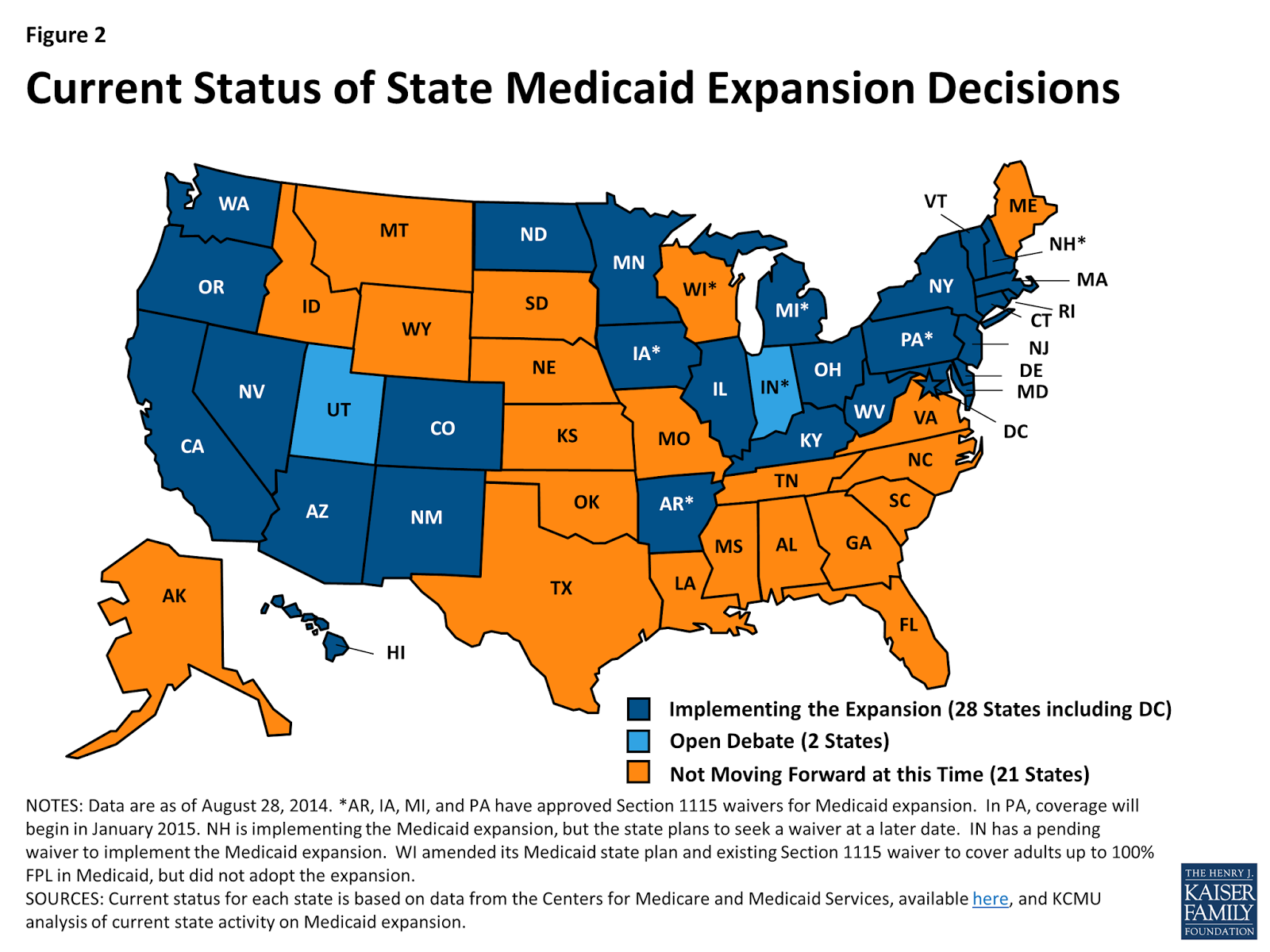
Not surprisingly, ADAP continue to thrive in the South...especially since most of the states in this region of the country have not expanded their Medicaid programs under the ACA. Among southern states, only Georgia witnessed a decreased in its ADAP enrollment (-0.03%). All of the other states saw increases in their ADAP enrollment, including an 8% increase in Alabama, 4% increase in Arkansas, 7% increase in Florida, 27% increase in Louisiana, 3% increase in North Carolina, 5% increase in South Carolina, 10% increase in Tennessee, 6% increase in Texas, and 4% increase in Virginia. Mississippi didn't not provide data on its enrollment.[3]

Map of the U.S. showing the States that have expanded Medicaid, still debating expansion, and not moving forward at this time.

One thing is clear from NASTAD's 2015 National ADAP Monitoring Project Annual Report: ADAPs continue to provide an important safety net of last resort. This year's report, along with other ongoing data collection reports, provide the patient advocacy community with plenty of ammunition to educate policy-makers on the important of the AIDS Drug Assistance Programs, as well as other programs assisting under-served communities.

CLICK HERE to download the National ADAP Monitoring Project: 2015 Annual Report.

_____________

[1] National Alliance of State & Territorial AIDS Directors, "FINDINGS OF THE 2015 NATIONAL AIDS DRUG ASSISTANCE PROGRAM (ADAP) MONITORING PROJECT ANNUAL REPORT," May 12, 2015.
[2] National Alliance of State & Territorial AIDS Directors, "2015 National ADAP Monitoring Project Annual Report, Table 6: Total Clients Enrolled and Served, June 2013 and June 2014," p. 46, May 12, 2015.
[3] National Alliance of State & Territorial AIDS Directors, "2015 National ADAP Monitoring Project Annual Report, Table 6: Total Clients Enrolled and Served, June 2013 and June 2014," p. 46, May 12, 2015.

Friday, May 15, 2015

Need for National Data on HCV Prevention, Care, and Treatment to Impact the National HCV Epidemic

By: Marissa Tonelli, Senior Manager, HealthHCV Initiative

The Centers for Disease Control and Prevention (CDC) estimates 3.2 million people in the United States are living with chronic hepatitis C infection; 80% of whom will develop chronic liver disease, close to a quarter of whom will go on to develop cirrhosis; and, about 5% of whom will die as a result of chronic HCV infection.[1]  These continue to be estimates as a result of limited national data and the disparate nature of the datasets, which have been barriers to fully understanding the extent and details of the national HCV epidemic. Without a fully resourced, national hepatitis surveillance system, clinical providers and public health officials rely on limited data to inform decision-making. According to the European Association for the Study of Liver Disease (EASL) Recommendations on Treatment of Hep C, inaccurate data, as well as lack of data for specific sub-populations, is an element hindering the design of effective public health interventions and limits the development of provider guidelines.[2]  Collection and analysis of national data related to HCV prevention, care, and treatment is essential to informing effective public health and clinical interventions to impact the epidemic.

HealthHCV Survey
Last month, HealthHCV, an advocacy and education initiative of HealthHIV, launched its inaugural State of HCV CareTM national survey. Findings from this first-of-its-kind national survey will assist in setting the direction of HCV provider and consumer education efforts in 2015 and beyond. The data collected will provide stakeholders with a comprehensive look at how developments in HCV testing, access, and treatment have impacted provider and consumer behaviors around HCV care nationally.

HealthHCV included input from viral hepatitis advocacy groups, payers, and HCV care providers in the development of the survey, which will identify trends in the HCV landscape, and education and training needs of providers to deliver patient-centered, quality HCV care in a variety of care settings, including primary care. In addition, consumer/patient case studies on access and other issues will be identified to inform HealthHCV’s national awareness efforts and will be included in a national HCV access and adherence campaigns conducted by HealthHCV and several partners.

Collecting meaningful data on behaviors of healthcare providers around HCV prevention, care, and treatment will allow us to make better-informed decisions that improve quality of care. Additionally, the aggregate national data being collected will assist public health officials, policy makers, and advocates to see the a picture of HCV prevention and treatment barriers in the US.

To participate in the survey, go to: https://www.surveymonkey.com/s/YW2PLHK.

HealthHCV will present preliminary results from the survey during National Hepatitis Awareness Month activities in May 2015.

If you are interested in distributing the survey through your networks, please contact Marissa Tonelli, Senior Manager of HealthHCV, at marissa@healthhcv.org or 202-507-4726. For more information about HealthHCV, visit www.HealthHCV.org.
________
[1] Content source: Division of Viral Hepatitis and National Center for HIV/AIDS, Viral Hepatitis, STD, and TB Prevention
[2] European Association for the Study of Liver Disease (EASL), EASL Recommendations on Treatment of Hep C, April 2014

________
Disclaimer: Guest blogs do not necessarily reflect the views of the ADAP Advocacy Association, but rather they provide a neutral platform whereby the author serves to promote open, honest discussion about public health-related issues and updates. 

Friday, April 17, 2015

The Affordable Care Act and the Ryan White Program for Persons with HIV/AIDS

By: Brandon M. Macsata, CEO, ADAP Advocacy Association

The Patient Protection and Affordable Care Act (PPACA), or the Affordable Care Act (ACA) – also known as Obamacare – continues to unfold and its overall impact is still yet unknown. Most of the law’s major provisions were phased in by January 2014, with other provisions phased in by 2020. The ACA has numerous implications generally on the United State’s health care delivery system, but more specifically on the supports and services afforded to people living with HIV-infection, or viral Hepatitis, under the Ryan White CARE Act. What’s more, ongoing Medicaid expansion (or lack thereof) and the implementation of insurance exchanges will also impact nearly all healthcare providers, as well as their patients.[1]

Unfortunately, people living with HIV-infection have experienced some of the unintended consequences of the law – including discriminatory practices limiting their access to care and treatment. As patients have obtained a basic understanding of the ACA’s provisions, they have also learned numerous ways to assist with their advocacy to combat such unlawful practices.

Cartoon of patient opening a box that reads, "Do It Yourself Insurance Exchange," with a telephone and manual falling out of the box. The manual reads, "Obamacare Handbook."

Among them, patients have received guidance from federal agencies on the law's intersection with existing public health programs, especially as its relates to HIV/AIDS and Viral Hepatitis populations. They acquired information about insurance “adverse selection.” And thanks to many advocacy and legal organizations, they have developed a greater understanding of potential impact discriminatory practices, as well as non-discrimination protections.

One such organization assisting patients is The AIDS Institute (TAI). Last year, TAI and the National Health Law Program (NHeLP) filed a complaint with the federal government against several health plans in Florida, accusing them of engaging in discriminatory practices against people living with HIV-infection. That complaint has already yielded positive results for patients, evidenced by Aetna (one of the companies named in the complaint) agreeing to reduce patient costs for HIV medications nationwide in the qualified health plan marketplace.

“Aetna’s announcement will help ensure that people living with HIV/AIDS throughout the country will have greater access to essential medicines at a more affordable cost,” said Michael Ruppal, Executive Director for The AIDS Institute. “However, there are still many other insurers who are charging patients excessive costs for their HIV medications and this does not impact a patient’s non-HIV medications or other beneficiaries with other health conditions. We look forward to working with Aetna and other insurers to address continuing barriers to care and treatment, including inadequate drug formularies, high cost co-insurance & deductibles, and restricted networks for people with HIV/AIDS, hepatitis, and other chronic health conditions.”[2]

Screenshot of healthcare.gov website, "Find health coverage that works for you."

In an effort to paint a clearer picture of the ACA's impact on patients, TAI has launched a survey for people living with HIV-infection to share their experiences.

This survey is for people who are living with HIV/AIDS and have had an experience with their healthcare that they would like to share. We are especially interested in those individuals that have had changes to their healthcare occur since October 1, 2013. Ryan White, AIDS Drug Assistance Program (ADAP), AIDS Insurance Continuation Program (AICP), Affordable Care Act - Marketplace Insurance Plans, Medicaid, Medicare programs are of particular interest.[3]

To complete the survey, CLICK HERE.

__________

[1] ADAP Advocacy Association, "Impact of the Affordable Care Act, Medicaid Expansion & Insurance Exchanges on HIV/AIDS & Viral Hepatitis Services," November 6, 2013. 
[2] The AIDS Institute, "Aetna Agrees to Significantly Reduce Patient Costs," March 26, 2015.
[3] The AIDS Institute, "The Affordable Care Act and the Ryan White Program for Persons with HIV/AIDS," April 2015.