Showing posts with label Ending the HIV Epidemic: A Plan for America. Show all posts

Thursday, May 28, 2020

Missouri Governor Issues Proclamation on HIV/AIDS

By: Sarah Hooper,  intern, ADAP Advocacy Association, and rising senior at East Carolina University

In a recent proclamation by Republican Missouri Governor Michael L. Parson, the month of April was designated HIV Awareness Month. He is the first governor to issue a proclamation acknowledging the national "Ending the HIV Epidemic: A Plan for America." The Missouri proclamation references testing (diagnosis), treatment and prevention.

The Ending the HIV Epidemic ("EHE") plan - announced in 2019 - was developed by agencies across the U.S. Department of Health and Human Services (Offices of Infectious Disease). EHE provided 57 geographic focus areas where HIV transmission occurs at a high rate, and Missouri is one of only seven entire states that is a jurisdiction of focus. The goal of the EHE is to reduce new HIV infections by 75% by 2025 and by at least 90% by 2030 by focusing on four pillars: prevention, diagnosis, treatment, and outbreak response by working with programs, resources and the infrastructure of HHS agencies and offices nationwide (Offices of Infectious Disease).

Nationally, HIV/AIDS Awareness Month is usually recognized in December, but Governor Parson chose to hold the month of recognition in April. Missouri has 447 annual HIV diagnoses as of 2018 and estimates 12,529 total people living with diagnosed HIV. However, only 87% have knowledge of their HIV status, leaving many more individuals who may be living with the virus and completely unaware (CDC).

When left undiagnosed, HIV positive individuals can transmit to others unknowingly and the virus may progress within their own bodies to the point of serious consequences. Governor Parson addresses diagnosis in his proclamation as one of the four pillars vital to addressing the HIV epidemic in America.

A resolution in support of the HIV Viral Load Suppression in Improving Health Outcomes and Reducing Transmission was adopted by many members of the National Lieutenant Governors Association ("NLGA") in March of 2019. State governors who sponsored the resolution included Wisconsin, Hawaii, Delaware, Missouri, Virgin Islands, Kansas and Vermont.

The sponsorship of Missouri’s Lt. Governor Mike Kehoe may have helped to push the Missouri Governor’s recent proclamation to light and stressed the importance of HIV awareness. The NLGA resolution reads, in part:

“Whereas, over 1.2 million people living in the United States are infected with HIV, and one in eight is unaware of the infection… Whereas, viral load suppression not only improves individual health, but it also reduces HIV transmission on a population level.” (2019, March)

By addressing the HIV epidemic on a state level and national level, progress will begin to accelerate in each state. Missouri’s Governor has set a great example to other states on how to begin addressing the HIV Epidemic and bring awareness to a virus that had such a “taboo” stigma surrounding it for many years. Many advocates believe this proclamation will save lives and help de-stigmatize HIV for those who still may hold certain negative views around the virus and those who are living with it.

Since 1981, more than 700,000 Americans have lost their battle to HIV (Offices of Infectious Diseases). While the numbers of infections and deaths have declined over the years with the increase of HIV education, the issue remains: those who may spread the virus without knowledge. I truly believe that both the Missouri and National plan to stop the spread of HIV and better educate the general public on the virus will help to destigmatize the disease and help lower the number of cases nationwide.

References:
  • Geographic Priorities. (2020, May 21). Retrieved from https://www.cdc.gov/endhiv/priorities.html?CDC_AA_refVal=https://www.cdc.gov/endhiv/data.html
  • Office of Infectious Disease. (2020, May 8). Overview. Retrieved from https://www.hiv.gov/federal-response/ending-the-hiv-epidemic/overview
  • Resolution In Support of HIV Viral Load Suppression in Improving Health Outcomes and Reducing Transmission. (2019, March). Retrieved from https://nlga.us/wp-content/uploads/Resolution-In-Support-of-HIV-Viral-Load-Suppression-in-Improving-Health-Outcomes-and-Reducing-Transmission-2.pdf
Disclaimer: Guest blogs do not necessarily reflect the views of the ADAP Advocacy Association, but rather they provide a neutral platform whereby the author serves to promote open, honest discussion about public health-related issues and updates.

Thursday, September 19, 2019

HIV/AIDS Fireside Chat Retreat in Virginia Tackles Pressing Issues

By: Brandon M. Macsata, CEO, ADAP Advocacy Association

The ADAP Advocacy Association hosted an HIV/AIDS "Fireside Chat" retreat in Richmond, Virginia among key stakeholder groups to discuss pertinent issues facing people living with HIV/AIDS. The Fireside Chat took place on Thursday, September 12th, and Friday, September 13th. Medicaid Expansion, Ryan White HIV/AIDS Program ("RWHAP"), and Patient Assistance Programs (PAPs) were dissected by 23 diverse leaders in the fight against the HIV/AIDS epidemic.

FDR Fireside Chat
Photo Source: Getty Images

The Fireside Chat included moderated white-board style discussion sessions on the following issues:
  • Medicaid Expansion: Implications for Access to Care & Service Delivery for PLWHA in Virginia — moderated by Dr. Kathleen A. McManus, Department of Medicine,University of Virginia
  • Ryan White Program: Impact to Service Delivery under Trump's Plan to Eliminate AIDS by 2030 — moderated by Jeffrey S. Crowley, O'Neill Institute for National and Global Health Law, Georgetown Law
  • Access to Care: How Patient Advocacy Groups & Patient Assistance Programs Fill Treatment Gaps for PLWHA — moderated by Alan Richardson, Patient Advocate Foundation
The discussion sessions were designed to capture key observations, suggestions, and thoughts about how best to address the challenges being discussed at the Fireside Chat. The following represents the attendees:
  • Carnelle Adkins, Lead Case Manager, Capital Area Health Network
  • William E. Arnold, President & CEO, Community Access National Network (CANN)
  • Jeffrey S. Crowley, Distinguished Scholar & Program Director at the Infectious Disease Initiatives, O'Neill Institute for National and Global Health Law, Georgetown Law
  • Dawn Patillo Exum, Director, Public Policy, MERCK
  • Kathie Hiers, President & CEO, AIDS Alabama
  • Lynea Hogan, Virginia Consumer Advocate
  • Lisa Johnson-Lett, Treatment Adherence Specialist /Peer Educator, AIDS Alabama
  • Diana Jordan, Director of Disease Prevention, Virginia Department of Health
  • Darnell Lewis, Local Coordinator ACCELERATE, TCC Group
  • Brandon M. Macsata, CEO, ADAP Advocacy Association
  • Kathleen McManus, Physician, University of Virginia
  • John Minneci, Regional Account Executive, ViiV HealthCare
  • Herminia Nieves, Assistant Director of Medication Access, Virginia Department of Health
  • Theresa Nowlin, Massachusetts Consumer Advocate
  • Juan Pierce, Virginia Consumer Advocate
  • Alan Richardson, Executive Vice President of Strategic Patient Solutions, Patient Advocate Foundation
  • Josh Robbins, Owner, BNA Talent Group & The BRANDagement
  • Kimberly Scott, Director of HIV Care Services, Virginia Department of Health
  • Matt Sheffield, Director, Government Affairs, Thera Technologies
  • Robert Skinner, President & CEO, Valley AIDS Information Network
  • LaWanda Wilkerson, North Carolina Consumer Advocate
  • Marcus Wilson, National Policy & Advocacy Director, Johnson & Johnson
  • Jennifer Zoerkler, Executive Director, VHO
The ADAP Advocacy Association is pleased to share the following brief recap of the Fireside Chat.

Medicaid Expansion:

Dr, Kathleen McManus summarized how Medicaid expansion under the Affordable Care Act has played a major role in the uninsured rate declining from 18% to 14% among people living with HIV/AIDS. In Medicaid expansion states the decline was event more visible, down from 14% to only 7% (with Ryan White clients classified as uninsured clients). In Virginia, for example, Medicaid eligibility was one of the most restrictive programs in the nation.

That said, barriers remain under Medicaid expansion. Sometimes more restrictions exist under Medicaid, such as closed drug formularies (often times more restrictive than ADAP drug formularies), mail-order pharmacy requirements, or providers being out-of-network. The ongoing challenges also remain with insurance carriers dropping plans under the ACA's marketplace. Some potential strategies to combat challenges created by the uncertain insurance market included state health departments leveraging existing relationships with insurance carriers, as well as increasing peer-to-peer education. The National Alliance of State & Territorial AIDS Directors ("NASTAD") has made available several important resources to help state health departments and Ryan White Programs navigate the Medicaid expansion landscape.

Medicaid expansion in Virginia has raised some important questions, including transitions for existing ADAP clients, access to care with Medicaid Managed Care Organizations, and upcoming Medicaid work requirements. “The Graying of HIV” was central throughout the Medicaid expansion discussion.

The following materials were shared with retreat attendees:
The ADAP Advocacy Association would like to publicly acknowledge and thank Kathleen for facilitating this important discussion.

Ryan White Program:

The Ryan White HIV/AIDS Program was discussed as a follow-up to the Michigan Fireside Chat, mainly as it relates to the Administration's plan to End the Epidemic by 2030 (EtE) initiative. As a foundational point for this discussion, some important facts were shared on why is the Ryan White Program needed if people with HIV have health insurance coverage, especially its role in leading the way in getting people with HIV virally suppressed by ensuring stable access to HIV primary care and medication, along with critical support services. Some of the issues touched upon included the impact of the uneven Medicaid expansion landscape from state-to-state, ADAP-funded insurance premium assistance, and mental health.

The EtE's targeted approach focuses on 46 counties in the United States, which account for over half of the new infections (there are over 3,000 counties nationwide). It was widely recognized that the plan does include a significant down payment to fund the initiative, but concerns linger over the ongoing assault on the Affordable Care Act. The Administration's plan also provided the opportunity to evaluate the ongoing rise in sexually transmitted diseases, which include worrying trends (22% increase in Chlamydia, 67% increase in Gonorrhea, and 80% increase in Syphilis). Additionally, PrEP was discussed as a way to improve population-level outcomes.

HIV Cluster
Photo Source: CDC

Finally, there was considerable discussion over the emerging controversy surrounding the use of cluster detection to pinpoint HIV hotspots. Whereas many health departments and public health professionals applaud using cluster detection (described as a tool), many patient advocates and people living with HIV/AIDS are increasingly alarmed over it. Emerging concerns include privacy, stigma, and criminalization.

The following materials were shared with retreat attendees:
The ADAP Advocacy Association would like to publicly acknowledge and thank Jeffrey for facilitating this important discussion.

Patient Assistance Programs:

Earlier this year the Patient Advocate Foundation ("PAF") blogged about Navigating the Costs of HIV Care – Conversations, Resources & Patient Experience, which summarized two online survey assessments of patients to identify root causes of financial toxicity including preferences towards cost conversations, degree and sources of financial stress. These surveys provided an important backdrop of this discussion about patient assistance programs ("PAPs").

The complexity of the nation's healthcare system and safety net programs often create "gaps" and the potential for patients to fall through them, thus losing access to timely, appropriate care and treatment. PAPs often provide the necessary resources to fill many of the care and treatment gaps. Some of the programs discussed included co-payment relief programs, case management services, and patient navigator programs.

Co-Pay Relief Program
Photo Source: PAF

Questions asked included what are manufacturer free drug programs and how do they operate, what are Coupon Cards and how do they work, and what is the difference between a manufacturer free drug program and charitable co-pay programs? Aside from the services provided by PAF, other patient resources offered by different organizations were also discussed, including the PAN Foundation, NeedyMeds, and PhRMA.

The following materials were shared with retreat attendees:
The ADAP Advocacy Association would like to publicly acknowledge and thank Alan for facilitating this important discussion.

Additionally, a special thank you is extended to Diana Jordan, Kimberly Scott and the entire Virginia Department of Health for their assistance during our stay in Richmond, VA.

Additional 2019 Fireside Chats are planned in New York, New York.

Thursday, June 27, 2019

HIV/AIDS Fireside Chat Retreat in Michigan Tackles Pressing Issues

By: Brandon M. Macsata, CEO, ADAP Advocacy Association

The ADAP Advocacy Association hosted an HIV/AIDS "Fireside Chat" retreat in Detroit, Michigan among key stakeholder groups to discuss pertinent issues facing people living with HIV/AIDS. The Fireside Chat took place on Thursday, June 20th, and Friday, June 21st. Safe Medicines, HIV Criminalization, and the Ryan White HIV/AIDS Program ("RWHAP") were dissected by 24 diverse leaders in the fight against the HIV/AIDS epidemic.

FDR Fireside Chat
Photo Source: Getty Images

The Fireside Chat included moderated white-board style discussion sessions on the following issues:
  • Safe Medicines: Combatting the Dangerous Foothold Counterfeit Medicines Have Gained in the U.S.moderated by Shabbir Safdar
  • HIV Criminalization: Ending the Stigmatization of the HIV/AIDS Epidemic, moderated by Robert Suttle
  • Ryan White Program: Impact to Service Delivery under Trump’s Plan to Eliminate AIDS by 2030, moderated by Jeffrey S. Crowley
The discussion sessions were designed to capture key observations, suggestions, and thoughts about how best to address the challenges being discussed at the Fireside Chat. The following represents the attendees:
  • Khadijah I. Abdullah, Founder & Executive Director, RAHMA & National Faith HIV/AIDS Awareness Day
  • Marjorie Ambrosio-Whitson, Vice President of Clinical Operations, ScriptGuideRx
  • Guy Anthony, President & CEO, Black, Gifted & Whole Foundation
  • William E. Arnold, President & CEO, Community Access National Network (CANN)
  • Olivier Bahizi, Advocate
  • Hala Bazzi-Lang, PharmD. RMGO, Local Specialty Registered Store Manager, Walgreens
  • Elmer Cerano, Retired & Board Member, ADAP Advocacy Association
  • Noel Chavez-Guizar, Clinic Case Manager, Rocky Mountain CARES
  • Tori Cooper, Founder & Executive Director, Advocates for Better Care Atlanta
  • Jeffrey S. Crowley, Distinguished Scholar & Program Director at the Infectious Disease Initiatives, O'Neill Institute for National and Global Health Law, Georgetown Law
  • Chris E. Davis, Attorney, Michigan Protection & Advocacy Service (MPAS)
  • Terry-Ann Francis, MPH, Global Professional Relations & Independent Medical Education, Global Medical Affairs, Merck
  • Stephen Hourahan, Consultant 
  • Lisa Irwin, Senior Manager, Project & Program Management, MagellanRx
  • Brandon M. Macsata, CEO, ADAP Advocacy Association
  • Stephen Novis, Government Relations Director, ViiV Healthcare
  • Murray C. Penner, Executive Director – North America, Prevention Access Campaign - U=U
  • Ioana Popa-Simil, Advocate
  • Alan Richardson, Executive Vice President of Strategic Patient Solutions, Patient Advocate Foundation
  • Josh Robbins, Owner, BNA Talent Group & The BRANDagement
  • Shabbir Imber Safdar, Executive Director, Partnership for Safe Medicines
  • Robert Skinner, President & CEO, Valley AIDS Information Network
  • Robert Suttle, Assistant Director, SERO Project 
  • Ian Wendt, Executive Director, HIV Community Operations, Gilead Sciences
The ADAP Advocacy Association is pleased to share the following brief recap of the Fireside Chat.

Safe Medicines:

According to Shabbir Safdar, 2019 has been an interesting year legislatively for the issue of pharmaceutical supply chain safety. Bills to attempt to legislate Canadian drug importation have been proposed in Utah, Colorado, Oregon, Missouri, Florida, Connecticut, and Maine. Bills have passed state legislatures in Colorado and Florida. These proposals attempt to create a pipeline of excess medicine, not needed by the Canadian population, to American patients.

One key question asked was can this work or are these bills actually implementable?
Prior experiments were reviewed, including: What has been the experience of other states that have implemented importation? Did it get used? Does it save money? What has changed about the market since the last programs in 2000-2010?
  • Illinois’ iSaveRX: Safety issues, missing inspections, terminated with low utilization
  • MN RXConnect: Safety issues, terminated with low utilization
  • Maine: No inspections, confirmed counterfeit, overturned in Federal court
  • Vermont: Not implemented yet, better savings through Medicaid, Projected savings to insurance companies: $2.61 to $2.82 per member, per month.
Questions over the politics of importation included: What has the rhetoric around these bills been like? Are state legislatures considering safety when passing them? Does spending time or money on legislation like this defer other priorities? Is this more of a soundbite than a real proposal?

During the meeting, some examples were shared of where a patient dollar for a pharmaceutical goes.  An infographic shows the complexity of how money flows in the U.S. healthcare supply chain.

The following materials were shared with retreat attendees:
The ADAP Advocacy Association would like to publicly acknowledge and thank Shabbir for facilitating this important discussion.

HIV Criminalization:

According to some estimates, 14% (or 1 in 7) of all people living with HIV (PLHIV) in the United States, and 20% (1in 5) of Black Americans living with HIV, will pass through a jail or prison every year. Though there is variation state to state, the prevalence of HIV in state and federal prisons in the United States is nearly five times greater than that of the general population.  The factors associated with disproportionate rates of incarceration -- such as drug use, non-conforming sexual and gender identity, mental illness, poverty, or being a person of color – can also augment a person’s risk of contracting HIV. Further, over 30 states have laws in place that criminalize alleged HIV exposure, non-disclosure, or transmission. Many states also apply harsher penalties to sex workers and people who inject drugs on the basis of HIV status. These laws perpetuate stigma of criminality, undercut public health, and disproportionately affect women, people of color, and other marginalized communities.

Photo Source: Queerty.com
Efforts to reform HIV criminal laws are underway across the U.S. In the last year alone, reform was proposed or achieved in several states. The experiences in these states offer numerous lessons:
  • Public health buy-in can be critical for success
  • The need to draw connection between different advocacy communities, including those focused on HIV, LGBTQ+ rights, mass incarceration, sex workers’ rights and harm reduction. 
  • In state legislatures education is critical and support can come from unexpected places. 
While HIV criminal laws must be reformed to address the overrepresentation of PLHIV in the criminal legal system, it is also essential to consider broader drivers of incarceration of PLHIV, including the war on drugs and discrimination against people of color and LGBTQ+ people in housing, employment, and education. Mass incarceration and HIV are linked epidemics, and the systemic injustices that drive mass incarceration also power the continued transmission and increasing prevalence of HIV in marginalized communities. Advocacy efforts, which seek to reform HIV criminal laws without attention to broader community-level factors impacting risk of incarceration for PLHIV are incomplete.

The following materials were shared with retreat attendees:
The ADAP Advocacy Association would like to publicly acknowledge and thank Robert for facilitating this important discussion.

Ryan White Program:

The Ryan White HIV/AIDS Program was discussed, as well as the potential intersection with the Administration's plan to End the Epidemic by 2030 (EtE) initiative. As a foundational point for this discussion, some important facts were shared on why is the Ryan White Program needed if people with HIV have health insurance coverage, especially its role in leading the way in getting people with HIV virally suppressed by ensuring stable access to HIV primary care and medication, along with critical support services.

The discussion included a summary on the progression from 2010 National HIV/AIDS Strategy to 2015 Strategy to Trump Administration plans. Additionally, it reviewed what is the role of the Ryan White Program and HRSA/HAB leadership in this initiative, as well as what are the opportunities and challenges with this effort?

Ending the Epidemic
Photo Source: HIV.gov

There was considerable debate on where the HIV community stands on the EtE initiative, which led to a broader conversation whether it is possible to define the "community" since there are often significant disconnects between national, state, and grassroots opinions.

With ongoing concerns over the current Administration, Ryan White reauthorization was weighed in the context of the current political environment. Yet there was recognition that the program would need to be updated at some point in time. That discussion led to a broader conversation on how is the program addressing emerging or other issues (Rapid Start of ART, HCV Elimination, Opioid/SUD response, STIs, other issues).

The following materials were shared with retreat attendees:
The ADAP Advocacy Association would like to publicly acknowledge and thank Jeffrey for facilitating this important discussion.

Additional 2019 Fireside Chats are planned in Richmond, Virginia, and New York, New York.


Thursday, March 21, 2019

Where the Rubbers Meet the Road on "Ending the HIV Epidemic: A Plan for America"

By: Marcus J. Hopkins, Policy Consultant

In his 2019 State of the Union Address, Donald Trump asked for a bipartisan committee to end the HIV epidemic in the United States within 10 years. Those of us who work in HIV activism and advocacy were (and still are) incredulous, given the Trump Administration’s penchant for undermining virtually every public health initiative.

President Trump outlines a plan to 'eliminate' HIV in the US by 2030
Photo Source: Business Insider

A mere five months prior to his announcement, the Trump Administration (TA) put the kibosh on HIV cure research because it used fetal tissue donated by women who have legal abortion in an effort to appease faux religious liberty activists (Wadman, 2018).

Also, in 2018, the TA released plans to take $3.8 million from HIV/AIDS programs and $5.8 million from the Ryan White HIV/AIDS Program (Kopan, 2018).

Before that, Trump “fired” the reaming members of the Presidential HIV/AIDS Council (formed in 1995 by President Bill Clinton) after six members quit the council in June 2017 in response to TA’s removal of the Office of National AIDS Policy website and Trump’s failure to appoint anyone to lead the White House Office of National AIDS Policy (Thomsen, 2017).

The announcement by Trump that his administration suddenly cares about ending HIV/AIDS came as a surprise to virtually everyone amid continually piling evidence to the contrary. There has been little evidence to support the idea that the TA is concerned with much of anything other than furthering initiatives that, in virtually every other administration, would have resulted in immediate reprisal from Congress.

So, what, really, is the TA’s grand plan to elimination HIV/AIDS by 2030? Health and Human Services (HHS) Secretary, Alex Azar, revealed their proposal, “Ending the HIV Epidemic: A Plan for America,” on February 7th, 2019 (HHS, 2019):

The plan has two primary goals: 1.) Reduce new HIV infections by 75% within five years; 2.) Reduce new HIV infections by 90% within ten years.

These goals will purportedly be reached using three major areas of action: 1.) Increasing investments in geographic hotspots through our existing, effective programs, such as the Ryan White HIV/AIDS Program, as well as a new program through community health centers that will provide medicine to protect persons at highest risk from getting HIV; 2.) Using data to identify where HIV is spreading most rapidly and guide decision-making to address prevention, care and treatment needs at the local level; 3.) Providing funds for the creation of a local HIV HealthForce in these targeted areas to expand HIV prevention and treatment (HHS).

They plan to focus these efforts on 48 high-burden counties, Washington, DC, San Juan, Puerto Rico, and 7 states with a substantial rural burden. How, you may ask? Well, they have four key strategies: Diagnose, Treat, Protect, and Respond – diagnose early, treat rapidly and effectively, protect uninfected populations, and respond rapidly to detect and respond to emerging HIV clusters to prevent new infections.

If this plan seems overly ambitious, it’s because it is.

Realistically speaking, adequately attacking the HIV/AIDS epidemic in the U.S. with the goal of ending it within 10 years is entirely possible…if we’re willing to pony up the resources required to realize that goal. Facts are facts: ending any epidemic is going to be costly, and the Feeral Fiscal Year (FY) 2019 budget for HIV of $34.8 billion dollars isn’t going to come anywhere near close to achieving this goal.

Why? Two words: “Rural America.”

At the beginning of the AIDS epidemic in the 1980s, people who lived in rural parts of the country felt “safe” from HIV/AIDS, because it “…only affected those big city queers.” This thinking dwelled in a peculiar place in the American psyche that believed that Americans largely remained in one place for their entire lives. And then, the 1950s happened…and the 60s, and 70s. As automobiles because more affordable, more Americans left their hometowns and relocated around the country to seek better opportunities and lives. Younger generations were moving out of the hills and hallows of their youths and into…why, they could just go anywhere! With this freedom of movement came certain costs – namely, the spread of infectious diseases.

Travel has always been the enemy of contagion containment, from the earliest days of commerce and conquest when trader ships brought to Europe the deadliest plagues Earth had to offer. So, too, was the case with HIV/AIDS. The idea that a sexually transmitted disease could be contained to metropolitan areas was a quaint notion. People travel to cities; people often have sex in cities (hell, there’s a whole cable series dedicated to the topic); people come back home and bring with them any STDs/STIs they might have picked up and spread them within their local communities.

What has not consistently been the case is that easy access to travel will mean that services will reach the same rural and/or remote places as those diseases. With America’s for-profit healthcare model, healthcare providers must generate a profit in order to remain open; statistically speaking, it is highly unlikely that those providers are going to opt to open locations in the very small towns where services are most needed, because the demand either doesn’t exist, or the residents can’t afford it.
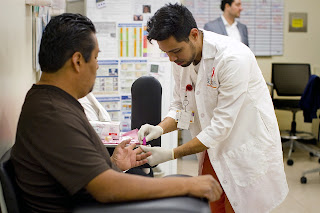
Medical Assistant Hector Reyes administers an HIV blood test to a patient at St. John's Well Child and Family Center on March 18, 2014 in Los Angeles.
Photo Source: Gina Ferazzi / Los Angeles Times via Getty Images file

Geographic barriers to care are an immense problem for a variety of reasons:
  1. Remote parts of the country are not always easily accessible throughout the year – snowfall, flooding, and even seasonal road conditions severely limit both patients’ and providers’ abilities to access and/or provide care;
  2. Telemedicine services are extremely limited in many of these rural areas, because high-speed Internet services and cell phone services are either severely limited or nonexistent – it takes a lot of money to fund expanding high-speed Internet access to rural areas;
  3. Distances to and from healthcare service provision can prove insurmountable for many rural Americans – it’s too costly to travel by vehicle due to gas prices and vehicle maintenance; little to no public transportation exists to take people to and from appointments; a trip to the doctor can consume literally an entire day, which means lost hours at work that cannot easily be recovered.
I know these things because I have personally experienced them. I’ve moved 43 times in my 37 years on this earth and have had HIV services in four different states – Florida, Tennessee, California, and West Virginia. Only in Ft. Lauderdale, FL was it easy for me to get to and from doctor’s appointments without spending entire days. In Tennessee, it took me literally weeks to even find out basic information about the state’s Ryan White program (which did not, in 2008, have a website). In California, though I lived in Long Beach, the nearest location where I could be treated was in Torrance, CA – a mere 15.1 miles on a map, but an hour or longer drive, each way, to get to and from appointments that would last entire days.

This brings me to my current state – West Virginia. In West Virginia, I luckily live close to one of the two Ryan White HIV/AIDS Program Medical Provider clinics. That’s right – there are only two Ryan White clinics in the state of West Virginia – one in Charleston, and one in Morgantown. By Interstate travel, these two cities are 156 miles apart, meaning that everyone in the middle and on the outskirts of the state – where Interstate travel is not always available or easy to access – may end up spending hours driving to and from appointments.

Another client at the WVU Positive Health Clinic in Morgantown, WV drives two hours each way to get to his doctor’s appointments, each of which can last up to three or four hours. For him, this means up to an eight-hour day solely dedicated to accessing HIV care and treatment, traveling along poorly maintained state routes and country roads. Luckily, he has progress well enough in his treatment to be on six-month visits, but realistically, each of these trips is a hassle. If he is sick, injured, or otherwise unable to travel, that means a missed appointment with a long waiting period before he can be seen, again.

These anecdotal evidences aren’t just true for West Virginia, but for the majority of the country. All around the U.S., patients living with HIV in rural areas spend entire days just going to their HIV doctor. And this is the crux of the problem for not only the Trump Administration, but any future administration: in order to truly eliminate HIV/AIDS in the U.S. by 2030, it’s going to require a massive increase in financial and human resources to tackle reaching rural America.

Part of the TA’s proposal focuses on states that already have high rates of HIV transmission in rural areas – Alabama, Arkansas, Kentucky, Mississippi, Missouri, Oklahoma, and South Carolina. These states do have high burdens of rural transmission, with 10% or more of new infections occurring in rural areas. What the current plan fails to take into account, in my opinion, is the growing risk of infection via Injection Drug Use (IDU).

Trump health chief supports needle exchange programs to prevent new HIV infections among drug users http://hill.cm/hJGrp1Q

IDU is already contributing to high rates of Hepatitis C (HCV) infections in places like West Virginia. In 2015, the rate of new HCV infections was 3.4 (per 100,000); in 2016, that rate increased to 5.1; in 2017, the rate increased, again, to 9.1 (WV Department of Health and Human Resources, 2018). A majority of the Hepatitis B (HBV) and HCV cases in WV reported IDU or street drug use as the primary risk of infection.

It’s not a big leap to assume that, as was the case in Scott County, Indiana, IDU will lead to increased transmission of HIV in state with a high incidence of IDU. This means that there will need to be significant increases in intervention funding in rural states, not just in the small metropolitan cities like Charleston and West Virginia, but in areas that are less easily accessible. Those interventions come neither cheaply, nor without significant public opposition.

Frankly, I don’t believe that the current administration is either willing or able to pony up the kind of cash that will be required to fund the types of interventions needed to achieve their goal. We’re not just talking about reaching rural areas, although that’s the largest roadblock; we’re talking about hiring and training thousands of new personnel, paying for treatment for lower- and middle-income individuals who cannot afford the high price of HIV Anti-Retroviral (ARV) medications, covering transportation costs for both patients and medical personnel, purchasing testing supplies, paying for confirmatory testing and blood work (the latter of which can run into the thousands-of-dollars per patient), hiring, training, and deployment case workers to ensure medication/treatment/physician adherence. The list of things that are going to be required in order to accomplish this goal is so long and so costly, that I doubt it can feasibly be accomplished.

I’m going to be pegged as a naysayer; as a cynic. In realistic terms, what we’ve seen over the past thirty years is that, on average, they type of funding that is necessary to successfully deploy this kind of ambitious plan hasn’t been put on the table for decades. Within the HIV activist/advocacy community, we have been all but terrified to reopen the Ryan White program to reauthorization, out of fear that a Republican legislature will gut the funding down to the bare bones. And honestly, that’s not a fear that is without precedent. Outside of Defense spending, Republicans, on the whole, have been loath to increase funding for anything else without drastic spending cuts elsewhere – a strategy that is both shortsighted and destructive to public health initiatives.

I’ve attended numerous conferences where statements like the following have been made:
“The primary job of big HIV organizations is to ensure that we don’t lose any of the $35 billion dollars in funding that we have.”
This quote (which is a direct quote from an Atlanta area activist/advocate) is terrifying, because it not only indicates that there is fear amongst organizations that those funds will be cut, but that we cannot – and should not – be vocal about our needs. If we make too many waves or too much noise, we risk losing funding. As a result, we cannot be ambitious or innovative in tackling the rural HIV crises we face, because to do so will risk the funds we’re already using to address the underserved needs of people in urban areas.

So, yes – when it comes to the Trump Administration’s grand plans for HIV prevention, I am skeptical that they will succeed. They haven’t even tried to produce enough staff members to work on their own initiatives; what would lead us to think that they would do so to address a problem as widespread as HIV?

References:
  • Health and Human Services. (2019, February 07). What is ‘Ending the HIV Epidemic: A Plan for America’?. Washington, DC: United States Department of Health and Human Services: HIV.gov: Office of HIV/AIDS and Infectious Disease Policy: Federal Response. Retrieved from: https://www.hiv.gov/federal-response/ending-the-hiv-epidemic/overview
  • Kopan, T. (2018, September 20). Trump admin moves $260M from cancer research, HIV/AIDS and other programs to cover custody of immigrant children costs. Atlanta, GA: CNN: Politics. Retrieved from: https://www.cnn.com/2018/09/20/politics/hhs-shifting-money-cancer-aids-immigrant-children/index.html
  • Thomsen, J. (2017, June 17). Six resign from presidential HIV/AIDS council because Trump 'doesn't care'. Washginton DC: The Hill: Healthcare. Retrieved from: https://thehill.com/news-by-subject/healthcare/338296-six-resign-from-presidential-hiv-aids-council-because-trump-doesnt
  • Wadman, M. (2019, December 13). Updated: NIH says cancer study also hit by fetal tissue ban. Science. Washington, DC: American Association for the Advancement of Science: Science: News. Retrieved from: https://www.sciencemag.org/news/2018/12/trump-administration-has-quietly-barred-nih-scientists-acquiring-fetal-tissue
  • West Virginia Department of Health and Human Resources. (2018, July 01). Acute Hepatitis C Incidence Rate, 2007-2017. Charleston, WV: West Virginia Department of Health and Human Resources: Bureau for Public Health. Retrieved from: https://oeps.wv.gov/HCV/documents/data/acute_hcv_chart.pdf

Disclaimer: Guest blogs do not necessarily reflect the views of the ADAP Advocacy Association, but rather they provide a neutral platform whereby the author serves to promote open, honest discussion about public health-related issues and updates.