Showing posts with label lung cancer. Show all posts

Thursday, July 27, 2023

Smoking and its Impact on People Living with HIV

By: Ranier Simons, ADAP Blog Guest Contributor

Smoking-related diseases and death remain some of the most preventable health issues today. While the prevalence of smoking habits has been continuously declining, in 2021, 11.5% (28.3 million) of the general U.S. population aged 18 or older still currently smoked cigarettes.[1] The designation of “currently smoking” is defined as having smoked 100 or more cigarettes in a lifetime combined with present daily use or every few days. Data shows that the prevalence of cigarette smoking among people living with HIV (PLWH) is significantly higher than the general population, estimated to be between 34-47%.[2] This is an alarming trend because smoking reduces the life expectancy of PLWH who smoke compared to those that do not.[2] Additionally, 94% of lung cancers among PLWH who smoke could possibly be prevented by smoking cessation.[2]

Person holding cigarette
Photo Source: AIDSmap

There are several medical issues, other than lung cancer, among PLWH that are linked to smoking: bacterial pneumonia, heart disease, chronic obstructive pulmonary disease (COPD), and other non-AIDS-defining cancers.[3] Research shows that these same issues are also comorbidities that take the lives of PLWH about ten years sooner than the HIV-negative population.[5] Data also shows that smoking PLWH who have achieved viral suppression through consistent antiretroviral treatment are more likely to die from lung cancer than traditional AIDS-related causes.[4] Most importantly, HIV is an independent risk factor for smoking-related cancers.[3] This means that being HIV positive increases the risk of developing smoking-related cancer much higher than the odds expected from smoking alone. 

A recent study conducted at Florida International University aims to explore why HIV infection exacerbates the adverse health outcomes of conditions like COPD in PLWH who smoke.[5] A smoking robot takes the smoke from standardized research cigarettes and exposes HIV cells to the smoke. The specific cells are cells from the respiratory tract lining in HIV-associated COPD. The research aims to discover what encourages lung inflammation in PLWH, hoping to create treatments that reverse the damage to restore function or at least prevent further deterioration.[5]

Given the importance of encouraging smoking cessation among PLWH, it is crucial also to understand the characteristics of the populations of PLWH who smoke. To examine the comorbidities and characteristics of PLWH who smoke, a group of researchers investigated data from an ongoing study of PLWH in Washington, DC, called the D.C. Cohort Longitudinal HIV study. The DC Cohort study participants are PLWH who get their care from a group of fifteen medical care sites in Washington, DC. Clinical data is collected to help improve the treatment and outcomes of PLWH in the area. Researchers found that half of the 8,600 subjects are smokers.

Examination of the data revealed intersections of socioeconomics, gender, race, and comorbidities.[7] Almost half of the smoking subjects had a mental health disorder. Four percent suffered from cardiovascular disease, eight percent had cancer, and two percent had pulmonary disease. Those with mental health challenges were more likely to be female, white, and older; likely to be uninsured or have public health insurance; and have housing instability. Those with cardiovascular disease, cancer, or pulmonary disease were more likely to be older, female, non-Hispanic Black race/ethnicity, or with housing instability. Regarding other characteristics, about 75% of the smoking subjects were unemployed, 15% had private insurance, and 57% were younger than age 50.

Tobacco & HIV/AIDS
Photo Source: Breathe DC

These data points show how the population of PLWH who smoke is not a monolith in any way. Therefore, efforts to encourage smoking cessation must specifically meet those affected on the level of where they are in their lives. Success requires targeting particular subgroups of marginalized and high-risk individuals. Continued medical research into the specificity of how smoking affects PLWH differently is paramount as well. Research has even shown that PLWH metabolize nicotine faster than HIV-negative smokers, thus making it harder for them to stop smoking. 

One popular way suggested by some as a means to reduce the harm of smoking tobacco while still helping those with nicotine addictions is vaping, also known as e-cigarettes.[6] However, research suggests chemicals in e-cigarettes harm the heart and lungs. E-cigarettes that contain nicotine have been associated with elevated blood pressure and heart rate. The vaping products that do not contain nicotine have also been shown to be harmful due to their flavoring ingredients and other unknown proprietary chemicals. Moreover, e-cigarettes have been correlated with developing ailments like COPD in the same manner as combustible cigarette smoking.

Smoking cessation is another challenge, like substance abuse disorder, that needs to be normalized as part of the whole-person healthcare treatment of PLWH.

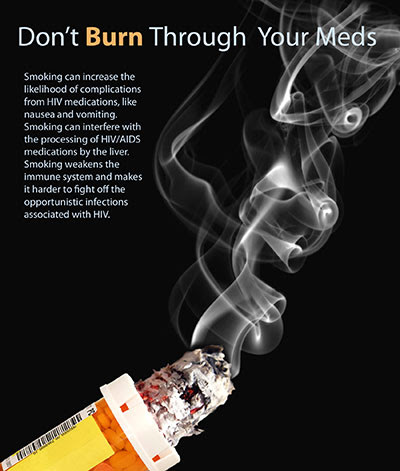
Don't Burn Through Your Meds
Photo Source: DC Tobacco Free Coalition

[1] CDC. (2023, May 4). Burden of cigarette use in the U.S. Retrieved from https://www.cdc.gov/tobacco/campaign/tips/resources/data/cigarette-smoking-in-united-states.html

[2] NIH. (2023, June 22). Tobacco and HIV. Retrieved from https://cancercontrol.cancer.gov/brp/tcrb/tobacco-hiv#:~:text=Over%201.2%20million%20people%20in,34%2D47%25%20smoke%20cigarettes

[3] U.S. Department of Health and Human Services. (2022, December 7). Smoking and HIV. Retrieved from https://www.hiv.gov/hiv-basics/staying-in-hiv-care/other-related-health-issues/smoking/

[4] Reddy KP, Kong CY, Hyle EP, et al. Lung Cancer Mortality Associated With Smoking and Smoking Cessation Among People Living With HIV in the United States. JAMA Intern Med. 2017;177(11):1613–1621. doi:10.1001/jamainternmed.2017.4349

[5] Varela, I. (2023, July 17).Robot helps researcher study effects of smoking on people with HIV. Retrieved fromhttps://news.fiu.edu/2023/robot-helps-researcher-study-effects-of-smoking-on-people-with-hiv

[6] Sforza, L. (2023, July 18). Vaping harms heart and lungs: American Heart Association. Retrieved from   https://thehill.com/policy/healthcare/4103481-vaping-harms-heart-and-lungs-american-heart-association/

[7] Wolters Kluwer Health. (2023, July 14). Gender, race and socioeconomic status are associated with comorbidity in people with HIV who smoke. Retrieved from https://medicalxpress.com/news/2023-07-gender-socioeconomic-status-comorbidity-people.html

Disclaimer: Guest blogs do not necessarily reflect the views of the ADAP Advocacy Association, but rather they provide a neutral platform whereby the author serves to promote open, honest discussion about public health-related issues and updates.   

Thursday, November 10, 2022

Non-AIDS-defining Cancers Among People Living with HIV/AIDS

By: Ranier Simons, ADAP Blog Guest Contributor

The advent of combination antiretroviral therapy (ART) has greatly improved the lives of people living with HIV/AIDS (PLWHA). ART has reduced HIV infection related morbidity and mortality overall and reduced the rates of AIDS defining cancers.[1] AIDS defining cancers are those that PLWHA are at a high risk for developing. When they develop these cancers, it usually means they have advanced from HIV to AIDS. Kaposi sarcoma, certain types of non-Hodgkin lymphoma, and cervical cancer are examples of AIDS-defining cancers.[2] In contrast to ART’s reduction of AIDS-defining cancers, while the risk is decreasing, the incidence of non-AIDS-defining cancers remains.[2] Non-AIDS-defining cancers are those that are more likely to appear in HIV-positive people. Lung cancer is the non-AIDS-defining cancer that appears the most. A recent study indicates that PLWHA remains at a higher risk and incidence of lung cancer compared to the population at large.[3]

Cancer
Photo Source: pratidintime.com

The study does not fully explain the causality of the higher incidence, however it does shed more light onto what is occurring. The U.S. National Cancer Institute performed a population-based registry linkage study using 2001–2016 data from the HIV/AIDS Cancer Match study, which links data from HIV and cancer registries from 13 regions in the USA.[4] There were 4,310,304 subjects followed in the study. During the study span 3,426 developed lung cancer. Compared to the general population, the data showed that PLWHA in their 40’s have twice the risk of developing lung cancer, PLWHA in their 50’s were 61% more likely, and PLWHA in their 60’s were 30% more likely to develop lung cancer.[3] It also noted that lung cancer surpasses Kaposi’s Sarcoma and Hodgkin’s Lymphoma as the leading cancer in PLWHA over the age of 50. That is a notable distinction given that Kaposi’s Sarcoma and Hodgkin’s Lymphoma are AIDS-defining cancers.

One factor contributing to the increased lung cancer incidence is smoking. Tobacco smoking rates are much higher among PLWHA than the general population.[5] There is evidence-based consensus that the lungs of PLWHA are especially susceptible to the harmful effects of cigarette smoke.[6] Additionally, due to HIV infection, their bodies are already in a constant state of inflammation. Cigarette smoking does not completely explain the higher lung cancer risk. Immunosuppression is also a factor. Although ART is very effective, there is still some immunosuppression due to HIV infection. By 2013-2016, half the study population had been living with HIV for at least ten years.[7] Researchers also found that the prognosis was worse and risk high for PLWHA who at any point previously had an AIDS diagnosis.[3] 

Don't Burn Through Your Meds
Photo Source: DCTCF

Medical research is continuing to investigate the etiology of lung cancer in PLWHA. Meanwhile, prevention is paramount. Most early lung cancer is asymptomatic. Thus, discovering cases early through screening before symptoms are seen will result in better outcomes. For some types of lung cancer, the survival rate is around 90% when tumors are discovered while small.[3] In the U.S., screening of adults with a smoking history, aged 50-80, is already recommended. The growing consensus is that screening of PLWHA needs to start earlier. Moreover, HIV status should be considered for inclusion in the entry criteria for lung cancer screening programs.[8]

[1] Moltó, J., Moran, T., Sirera, G., & Clotet, B. (2015). Lung cancer in HIV-infected patients in the combination antiretroviral treatment era. Translational Lung Cancer Research, 4(6), 678-688. doi:10.3978/j.issn.2218-6751.2015.08.10
[2] Cedars Sinai. (2022). AIDS-Related Cancers. Retrieved from https://www.cedars-sinai.org/health-library/diseases-and-conditions/a/aids-related-cancers.html
[3] 
Hudson, D. (2022, October 16). People with HIV are at twice the risk of lung cancer, study finds. Retrieved from https://www.queerty.com/people-hiv-twice-risk-lung-cancer-study-finds-20221016#.Y2J6PmVsaPA.twitter
[4] 
Engels, A. et al. (2022). Trends and risk of lung cancer among people living with HIV in the USA: a population-based registry linkage study. Lancent HIV, 9(10), 700-708. https://doi.org/10.1016/S2352-3018(22)00219-3
[5] Centers for Disease Control. (2022). People Living with HIV. Retrieved from https://www.cdc.gov/tobacco/campaign/tips/groups/hiv.html
[6] Rahmanian, S. et al. (2011). Cigarette smoking in the HIV-infected population. Proceedings of the American Thoracic Society, 8(3), 313-319. https://doi.org/10.1513/pats.201009-058WR
[7] Alcorn, K. (2022, October 11). Risk of lung cancer is higher for people with HIV. Retrieved from https://www.aidsmap.com/news/oct-2022/risk-lung-cancer-higher-people-hiv
[8] Hein, I. (2022, October 6). Lung cancer declining in people with HIV, but still high. Retrieved from https://www.medpagetoday.com/hivaids/hivaids/101100

Disclaimer: Guest blogs do not necessarily reflect the views of the ADAP Advocacy Association, but rather they provide a neutral platform whereby the author serves to promote open, honest discussion about public health-related issues and updates. 

Friday, December 8, 2017

You Wanna Buy Some Death Sticks?

By: Jonathan J. Pena

At the age of 15, I took a drag off of my first cigarette and like many teens it was a response to a curious nature that was coupled heavily by peer pressure. The cool menthol taste coating my throat gave me excitement knowing that in a few seconds I would be exhaling a puff of cascading smoke in front of my peers. From that point on, I can remember smoking up to two packs of cigarettes a day. My lungs hurt just thinking about it now. Smoking cigarettes, as we all know, is a terrible habit to pick up. It has many damaging chemicals and compounds that can lead to some serious illnesses that can be fatal. Living with HIV requires a focus on living a healthier life, so it begs the question: what are the consequences of lighting up while on antiretroviral treatment?

Star Wars scene with Obi-Wan Kenobi
Photo Source: Star Wars: The Clone Wars
In the United States, more than 4 in 10 people living with HIV are smokers, and people within this population are at great risk of dying from lung cancer according to a recent article published in POZ magazine. They also highlighted findings from a preceding published Danish research study in 2012 indicating that those who smoked and also were HIV-positive would lose 12 years of life in comparison to nonsmokers.[1] Poof, up in smoke! 

An additional study was noted by POZ Magazine from the research team at Massachusetts General Hospital that published their findings in JAMA Internal Medicine. They were interested in finding the estimated risk of lung cancer with people living with HIV in the United States. Through computer simulation the parameter of interest also include current, former smokers and those who never smoked. The study estimated that 25 percent of people who were smokers, HIV-positive and adherent to their antiretroviral (ARV) therapy would die of lung cancer. That number is estimated to be 6 percent if a smoker quits by 40 years of age.[2]

Some additional information was published by NAM's AIDS Map that further illustrates the growing concern with smoking and being HIV-positive. They indicated that in 2015, 40 percent of people living with HIV/AIDS in the United States were smokers. This was in contrast to only 15 percent of the general public. Additionally, what their finding show is that those who are adherent to their medication are 6 to 13 times more likely to die of lung cancer instead of an AIDS related sickness.[3]

I smoked for many years even after my HIV-positive diagnosis. I can understand why so many people living with HIV smoke. As a former smoker, I saw smoking as the one vice that I was able to allot myself because, heck, I was already HIV-positive so why the hell not? Thankfully, through fantastic leaps in modern medicine and no small amount of personal maturity, I am able to light up my life with healthier alternatives like exercising, eating well and continuing to adhere to my medication.

We owe it to ourselves to be more health conscious on what we put into our bodies, especially for those of us living with the virus. Our hands have the ability to do so many great things that involve creation, innovation, and love but all of that would be diminished or lost if we decide to replace it with "death" sticks.


Disclaimer: Guest blogs do not necessarily reflect the views of the ADAP Advocacy Association, but rather they provide a neutral platform whereby the author serves to promote open, honest discussion about public health-related issues and updates. 
__________

[1] POZ Magazine (2017, September 18); 1 in 4 Smokers on Successful HIV Treatment Projected to Die of Lung Cancer. Retrieved from https://www.poz.com/article/1-4-smokers-successful-hiv-treatment-projected-die-lung-cancer.
[2] POZ Magazine (2017, September 18); 1 in 4 Smokers on Successful HIV Treatment Projected to Die of Lung Cancer. Retrieved from https://www.poz.com/article/1-4-smokers-successful-hiv-treatment-projected-die-lung-cancer.
[3] Alcom, Keith. (2017, September 19). Smokers with HIV doing well on treatment now at greater risk of lung cancer than AIDS. NAM Publications. Retrieved from https://www.aidsmap.com/Smokers-with-HIV-now-at-greater-risk-of-lung-cancer-than-AIDS/page/3173651/.