Thursday, August 25, 2022

Reflections from an HIV Advocate's Journey: Alecia Tramel-McIntyre

By: Alecia Tramel-McIntyre, Founder & CEO, Positive People Network

Being a Cisgender Black Women who lives in Miami-Dade County, which is the epicenter of newly diagnosed HIV cases, I have a profound understanding of its influences in my life and advocacy work. As I look back over my life, I realize that it has been a long journey to the thriving advocate that I have become today. I was destined for something important, but I would have never thought that my life would become a force for change for myself and others living with HIV.  

Alecia Tramel-McIntyre

There are days in our life that we will always remember, as if it was yesterday. Having my first child on May 29th, 1990. Getting married for the first time when I was 39 and being diagnosed with HIV in October 2000. I even remember the doctor that gave me my diagnosis. And had the privilege of seeing him later in life. 

Today, I have the privilege of being included in some of the best organizations. I am the Founder and CEO of Positive People Network, Inc, a non- profit organization whose mission is to change the quality of life of people living with HIV/AIDS. We focus on education, awareness, social support, and prevention. 

I'm the Florida State Lead for Positive Women's Network (PWN), a member of BTAN Miami, Southern AIDS Coalition consumer advisory board member, CHARM consumer advisory board member for the University of Miami, Florida Community Health Worker Coalition, Florida HIV Justice Coalition member, Miami-Dade HIV/AIDS Partnership member, Chair of the Community Coalition of the Partnership,  Ribbon Organizing Center for HIV Aging Positively (ROC4Aging+) consumer advisory board member, National Community Action Board (NCAB) member, ICWNA board member, Blogger for A Girl Like Me with The Well Project, Florida Rights Restoration Coalition member, Florida HIV/AIDS Advocacy Network (FHAAN) member, Inductee in Leading Women's Society (LWS), a member of The MillionHeiress Club, an Ambassador of Health for Catalyst Miami 2011 – 2022, and a board member of the Women's March Miami. 

"Together we can end HIV"

I'm motivated to do all that I can to help eradicate stigma. I had the opportunity on the ground level to help re-citizens have our voting rights restored through Amendment 4 as a Field Organizer for Color of Change during the 2018 elections in Florida. Also, I participated as a member of the Florida Organizing for Power team to get the Positive Vote with PWN. I currently serve as the Co-chair for HOPE CAB (HIV Obstruction by Programmed Epigenetics) in California. I'm proud to be a U=U Ambassador for the Prevention Access Campaign. Being a U=U Ambassador, I proudly empower and educate the community on the facts and science of Undetectable=Untransmittable. And more recently, I was engaged as a community partner for the "I Am a Work of ART" campaign. And I have a commercial with the Health Council of South Florida as a part of their Ending the Epidemic campaign currently airing. And yes, I do sleep.

"Mr. & Mrs. HIV"

I'm proud to be married to a wonderful man who is also thriving with HIV. We, together, are self-proclaimed Mr. and Mrs. HIV, and we are living our best life. 

There is freedom in living your truth.

"There Is Life After Diagnosis, Live It"

Disclaimer: Guest blogs do not necessarily reflect the views of the ADAP Advocacy Association, but rather they provide a neutral platform whereby the author serves to promote open, honest discussion about public health-related issues and updates.

Thursday, August 18, 2022

Reflections from an HIV Advocate's Journey: Venton Jones

By: Venton Jones, MSHCAD, PMP, Chief Executive Officer, Southern Black Policy & Advocacy Network (SBPAN)

In June 2022, I recognized the 15th anniversary of my seroconversion. Reflecting on this huge milestone as a long term HIV survivor, I am humbled by the opportunities I have had to use my story and advocacy to make the world a better place for people living with HIV, communities of color, young people, and those who are part of the LGBTQ community. I would have never thought 15 years ago that I would be running to serve as a Texas State Representative, and becoming one of the first openly Black LGBTQ and HIV positive lawmakers to be elected to a state legislative body in the United States.

Venton Jones

On World AIDS Day 2021, I made the decision to run for Texas State Representative in the house district that I grew up in in Dallas. House District 100 is one that is a majority-minority district which has a population of almost 200,000 people of which 80% are constituents representing communities of color. The issues I have championed during my campaign are: healthcare, public education, jobs, the economy, infrastructure (including our power grid), and civil and voting rights.  

During my primary, I faced a lot of obstacles as a person living with HIV and first time political candidate, including an opponent who publicly attacked my HIV status and sexuality on the campaign trail. In the face of these attacks, I continued to run a race that was focused on service to the people, and on May 24th, I earned the Democratic nomination for the seat, and advanced to the General Election with almost 70% of the vote. Now I am continuing the work to win this position against an opponent in the General Election which will take place on November 8, 2022. 

I often reflect on my HIV and public health work over the past 20 years. I am grateful for my roots as an HIV advocate. So many of the lessons about service to the community and fighting for the voiceless started in this work for me. These lessons are ones that are deeply ingrained in who I am today. I stand proudly on the shoulders of those freedom fighters who gave their lives working to abolish HIV for Black and Brown communities. So much of the work that I have focused on during my life and career has influenced my campaign. 

Venton speaking at campaign event

As I continue this legislative race, I continue to ask for the support of the HIV community. Please continue to follow the campaign and support our efforts to increase representation of people of color, the LGBTQ community, and people living with HIV in elected office. You can find out more about my campaign by visiting ventonfor100.com.

Editor's Note: As a tax-exempt, nonprofit organization we cannot endorse Venton's candidacy, however, we did ask him to include a link to his campaign website due to the historic nature of his candidacy for Texas State House District 100. We invite you to learn more about him and his candidacy.

Disclaimer: Guest blogs do not necessarily reflect the views of the ADAP Advocacy Association, but rather they provide a neutral platform whereby the author serves to promote open, honest discussion about public health-related issues and updates.

Thursday, August 11, 2022

Reflections from an HIV Advocate's Journey: Chunnika L. Hodges

By: Chunnika L. Hodges, Michigan State Lead, Positive Women's Network-USA (PWN)

As I reflect on my journey as an advocate living with HIV, I would say that it has its ups and downs. At some point, I stepped back from the scene for a while. As much knowledge of HIV & experience with PLWH (familial) as I had at the time, I was still unaware of the risk (I was in a monogamous relationship. I say that because messaging surrounding women and HIV, let alone Black women and HIV, was not discussed or seen in 2005! Receiving a dual diagnosis of pregnancy and HIV at the age of 25, I was unprepared for the next steps, asking myself, was I going to terminate my pregnancy or go through this pregnancy? Mainly because of the way the medical professional delivered the news of me now having HIV and being pregnant. Upon entering the room, the doctor was like (after looking at the file), "Ms. Hodges, you're HIV positive and pregnant," and walked out of the door 90 seconds after delivering life-altering news. 

Chunnika L. Hodges

That day in September 2005, six-eight weeks before my 25th birthday, changed my life like I never thought it would. Shortly after giving birth to my daughter, who is now 16 years old and HIV negative (because of the HAART regimen available to prevent transmission during & after the birthing process), I started out doing speaking engagements; from there, it led to me connecting to a group of women just like me "Pregnant and living with HIV." Being a part of this group opened so many doors for me, mainly because I was the only young black woman living openly about her HIV status. I was not blasting from the stands; however, when teachable moments came up, I took advantage of the moment to educate and create awareness of the complexities of acquiring HIV. For instance, even though you may think that you are in a monogamous relationship, your partner may not be in that same relationship. My favorite statement to women when I talk is, "Get Tested…. You do not carry your partner's penis in your purse like it's the American Express Card; You do leave home without it," Meaning have those hard conversations, get tested together (if the opportunity arises), but be more proactive about your Sexual health care needs. Growing up with self-esteem issues, daddy issues, body image, etc., I was a hot mess internally and, therefore, externally, led to relationships that were what we now call unhealthy relationships. From that moment, moving forward, I became involved in any way I could, but not realizing the cost to myself because of the lack of knowing who I was as a Black woman. For a while, I was going through the motions of feelings of unworthy, nasty, low self-esteem, mentally & emotionally not good! I realized I had become a token in this advocacy journey. 

Chunnika L. Hodges at AIDS Walk, 2017
AIDS Walk, 2017

I say that because, before my diagnosis, I was not the confident woman people see today! As I write this blog to reflect, I have realized that my diagnosis has been a curse and a blessing at the same time. If that make sense? Diagnosis of HIV has given me the confidence &purpose to live out loud and unapologetically; also, because I am a unique case of a WLWH, the blessing is that I have not been on medication; only until eight weeks after giving birth to my daughter. The "curse" of this diagnosis is finding meaningful relationships (with self and others). As I reflect, I remember being in spaces where I would share my status and what that means and looks like for me. Some were intrigued by my uniqueness of living with HIV. While some displayed other types of expressions and comments,  like "she ain't got it." Words like this came from my "peers." Hurt like hell, but I never let those people see sweat. However, I internalized those feelings and started feeling like I did not belong in the journey of advocating for PLWH; why you may ask? It was for a few reasons: my story was not like the others I encountered when sharing their story. Not taking medicine, me being open about my status since being diagnosed. Earlier I mentioned that losing myself in this journey came as a cost to me. My identity was wraparound "a black woman living with HIV." But not knowing who I was before my diagnosis was the key to finding myself again. So I took a break from the journey to find out who I was and my purpose on this journey. After taking a hiatus, I came back knowing my purpose of educating about research on HIV and the importance of becoming involved and providing my experience as a black woman engaged in research studies. Some would say, why research? Earlier I spoke about my diagnosis being a curse and a blessing simultaneously. 

Although HIV is living with me, it has not defeated me by far. For the last 15 years, I have not had to take medicine to control or suppress my HIV, and as of 2012, in the National Institute of Health Long-Term Non-Progressor (LTNP) study and 2018, I was noted as an Elite Controller of HIV. Understanding the science behind my case of HIV drove me to become involved in research. The other blessing from this diagnosis has provided me with a privilege. The privilege is that I do not take medicine; having condomless sex before U=U became a hot topic after the Swiss Medical Journal article, and I am mentally strong upon my diagnosis, which remains today. 

Chunnika L. Hodges speaking at podium

Along with sharing my experience as a black woman living with HIV, I am so blessed not to have to experience some of the things other women living with HIV do, such as having the support of family, friends, mentors, etc. Pouring into me genuinely and finally becoming employed in the field has changed my life. Meeting people I never imagined meeting, going places I never thought I would go, etc. I was doing things and involved in projects, advisory councils, and the board of directors for a national network group of women living with HIV. I would not change a thing!  

But the takeaway from this reflection is that there will be times when there will be when you feel like giving up; in those times, remind yourself that it is okay to take a step back to redefine your purpose in this journey. Newly diagnosed with HIV, there is life after the diagnosis; the choice is yours on whether you want to thrive and live or exist. Find Your Tribe and Thrive to your fullest potential.

Disclaimer: Guest blogs do not necessarily reflect the views of the ADAP Advocacy Association, but rather they provide a neutral platform whereby the author serves to promote open, honest discussion about public health-related issues and updates.

Thursday, August 4, 2022

Reflections from an HIV Advocate's Journey: Kalvin Pugh

By: Kalvin Pugh, Senior Manager for Community Engagement, International Association of Providers of AIDS Care (IAPAC)

I’ve always felt like a rebel. Growing up as a gay kid in a religious home in Kansas will do that to you. My journey into advocacy began like any other advocate – it became personal. On May 22nd, 2016, I was given the results of my routine HIV test. This time, the results were different. I swore at the time that no one who didn’t need to know would.

That opinion changed a few months later after my friends and I were out when someone approached them and told them they shouldn’t be drinking after me. Rumors spread fast in smaller communities but instead of getting upset, I got curious. I became curious about how ideas like that survived the 80s and 90s and the rebellious kid in me wasn’t about to let others define who I was.

So, I turned to social media. I wrote (and rewrote) what I wanted to say, including, “I want to live a life unashamed of my truths, no matter what they are,” before I finally clicked post.

Kalvin Pugh

There were certainly a few friends who didn’t want to be associated with HIV. But then came a formative, discreet moment when I was approached by someone who told me that what I had shared had meant a lot and then whispered, “Me too.” That was the first time I understood that if you can say aloud the things others are afraid to whisper, you become a voice instead of a victim. 

After seeing a life changing video online of the incredible Bruce Richman, social media became my soap box where I shared my life and the revolutionary message of Undetectable Equals Untransmittable with anyone who would listen. 

Shortly after, I took a job as a peer educator, where I would worked for four years directly with clients including both newly diagnosed individuals and those for whom staying in care wasn’t easy. Throughout my time there, I learned from the best team of colleagues and a wonderful mentor in my supervisor LaTrischa.

Kalvin Pugh

In 2018, I was approached to become a patient ambassador for a pharmaceutical company. I was whisked off to training with nine incredible advocates, many who have become lifelong friends. That experience led to years of speaking engagements, magazine ads, and one TV commercial, which was the first time U=U had been featured in a nationwide campaign in the United States. 

A year ago, I was given the incredible opportunity to serve as senior program manager of community engagement for the International Association of Providers of AIDS Care. To be part of an incredible global team working to end the HIV pandemic has led me to grow, to learn more about myself, but most importantly to put people in the center of everything I do. 

I could talk about awards that sit on my bookshelf collecting dust, but that’s not what I value. It's the moments no one else has seen – the conversations behind closed doors with clients in the clinic, the messages on social media with people from all over the world – that have impacted me the most. Seeing people go from diagnosis and being scared that their life was over to the moments when they realize that their life has just begun – those moments are the greatest reward. 

Kalvin Pugh on rock-climbing wall

My journey from my diagnosis to now has been one of incredible privilege, access, and opportunities. It hasn’t been a cakewalk, but I have tried my best, in my own way, to use my privilege and the opportunities that have come to advocate for others.

So here I am six years later with so many lessons learned. I don’t know a lot, but I know that people living with HIV are my people. I don’t want to bring seats to tables that weren’t built for us, but rather build bigger and better tables. I want everything I do to honor those giants whose shoulders I stand on, and to make way for those who will certainly come after. 

I imagine I will always feel like that rebellious kid, but at least now, I’m a rebel with a cause.

Disclaimer: Guest blogs do not necessarily reflect the views of the ADAP Advocacy Association, but rather they provide a neutral platform whereby the author serves to promote open, honest discussion about public health-related issues and updates.

Wednesday, July 27, 2022

Spike in Monkeypox Disease Among MSM Causes Alarm, Too

By: Ranier Simons, ADAP Blog Guest Contributor

On Saturday, July 23, 2022, the World Health Organization (WHO) declared monkeypox a PHEIC, public health emergency of international concern.[1] Internationally, the number of cases has reached over 16,000 in over 75 European countries, North and South America, the Middle East, South Asia, Australia, and other parts of Africa not previously exposed.[1] In the United States, there have been roughly 2,900 cases. 

It is important to note that anyone can contract monkeypox. Monkeypox was first identified in 1958 in a colony of research monkeys.[2] Since 1970 human outbreaks have been reported in 11 African countries. The first outbreak outside of Africa was in 2003 in the United States. It occurred in several midwestern states and was linked to infected prairie dogs that people had as pets. Those pets likely contracted the disease from being housed with infected rats and door mice shipped from Ghana.

Monkeypox on hands
Photo Source: National Institute for Communicable Diseases

Although anyone can contract the disease, the recent outbreak disproportionately affects gay, bisexual, and men who have sex with men (MSM).[2] The U.S. Centers for Disease Control & Prevention (CDC), the media, and health professionals have consciously not labeled monkeypox a gay disease. It indeed is not a gay disease. However, given that the current outbreak mainly affects gay men, it is essential to clarify that explicitly. The award-winning blogger Mark S. King points out, "Gay men are getting monkeypox and suffering greatly. When gay men understand the threat, we are more likely to take precautions, get vaccinated, or be informed about treatment”.[3]

Concerns about stigma are valid. Gay men historically have and continue to face stigma and apathy in the healthcare arena and public opinion regarding healthcare issues. But, King also points out that it is dangerous to bury facts with vague and evasive messaging.[3] Vague messaging leads the general public to think that their present odds of contracting the disease are higher than the reality of the numbers. Conversely, labeling monkeypox a gay illness would make the public complacent about being mindful of their activities and being tested when they should be. 

The Washington Post’s Benjamin Ryan points out that “…public health experts know well, epidemiology is less concerned with whether someone could contract an infection; instead, the much more vital questions focus on which groups of people are most likely to be exposed to a pathogen, to contract it and why.”[4] There need to be targeted education and prevention efforts aimed at gay men to emphasize the specifics that make them more susceptible to the spread of monkeypox. Facts show that the sexual and social networks of gay men are why it is hitting the population hard. There have been clusters of infections traced back to events such as large circuit parties, nightclub events, and pool parties. Bathhouses are the settings of some clustered outbreaks, as well. Gay men need to be informed of the statistical fact of gay men having an increased incidence of multiple sex partners, especially in combination with certain events and travel, which also increases the likelihood of the spread of monkeypox amidst their demographic.

Monkeypox is contracted through close skin-to-skin contact. Transmission comes from exposure to broken skin, mucus membranes, respiratory droplets, infected bodily fluids, and even contact with contaminated linens. It is not airborne like Covid-19. Rubbing, kissing, and physical contact are enough to cause infection. Sexual intercourse is not necessary. Seven to fourteen days after infection is when symptoms usually appear. Fever, chills, exhaustion, headaches, and muscle weakness are typically initial signs.[2] Progression includes the swelling of lymph nodes and widespread body rash that can include the mouth, hands, and feet. Then fluid-filled painful pox can appear on the body, surrounded by red circles. There is increased reporting that some infected individuals only see some rash and painful pox sores in the genital and anal regions instead of all over the body.

Monkeypox tests
Photo Source: PBS

Over 190,000 doses of the two-dose Jynneos vaccine have been pulled from the Strategic National Stockpile. Jynneos is used for the prevention of monkeypox and smallpox. There is still not enough in circulation to meet the demand for vaccination nor to vaccinate all those in the highest risk categories. There is also an antiretroviral effective against monkeypox named TPOXX (tecovirimat), approved by the U.S. Food & Drug Administration (FDA) for use against smallpox in 2018.[5] Unfortunately, TPOXX was only authorized for smallpox because it is deadly and can be considered a possible bioterrorism weapon. Monkeypox is not fatal like smallpox. Thus obtaining TPOXX requires many pages of paperwork to get it from the Strategic National Stockpile. Additionally, protocol requires doctors to submit pictures of a patient's lesions to the local health department or CDC and a folio of pages of detailed information to get TPOXX. After getting the drug, patients are required to keep a daily journal while they are taking it.[5]

Presently, monkeypox prevention is paramount as vaccination and treatment options are scarce. Effectively educating gay, bisexual, and men who have sex with men with the unadulterated details of their demographics’ statistically documented behaviors put them at high risk is the best weapon against the spread of the disease. Targeted explicit information delivered with respect and dignity is the best way to avoid stigma while undergirding the importance of the information.

[1] Branswell, H. (2022, July 23). WHO declares monkeypox outbreak a public health emergency. Retrieved from https://www.statnews.com/2022/07/23/who-declares-monkeypox-outbreak-a-public-health-emergency/
[2] Howard, J. (2022, July 21). Monkeypox spreading in 'cluster events,' but vaccines can help stop it, local health officials say. Retrieved from https://www.cnn.com/2022/07/21/health/monkeypox-clusters-local-officials/index.html
[3] 
King, M. (2022, July 19). Monkeypox is a gay thing. We must say it. Retrieved from https://marksking.com/my-fabulous-disease/monkeypox-is-a-gay-thing-we-must-say-it/
[4] Ryan, B. (2022, July 18). You are being misled about monkeypox. Retrieved from https://www.washingtonpost.com/opinions/2022/07/18/monkeypox-gay-men-deserve-unvarnished-truth/
[5] 
Walsh, D. (2022, July 21). There Is a monkeypox antiviral. But try getting it. Retrieved from https://nymag.com/intelligencer/2022/07/tpoxx-is-a-monkeypox-antiviral-but-try-getting-it.html

Disclaimer: Guest blogs do not necessarily reflect the views of the ADAP Advocacy Association, but rather they provide a neutral platform whereby the author serves to promote open, honest discussion about public health-related issues and updates.   

Thursday, July 21, 2022

Resurgence of Meningococcal Disease Among MSM Causes Alarm

By: Ranier Simons, ADAP Blog Guest Contributor

Amidst the myriad of present-day public health concerns, including Covid-19 and monkeypox, there is another to add to the list. The U.S. Centers for Disease Control & Prevention (CDC) has raised the alarm regarding a surge in meningococcal disease. There has been an unusual surge of meningococcal disease in Florida.[1] The outbreak has been deadly, with 26 reported cases and 7 deaths. The CDC describes this outbreak as one of the worst meningococcal disease outbreaks among gay and bisexual men in U.S. history.[2] Twenty-four of the 26 documented cases and 6 of the 7 deaths thus far have been MSM (men who have sex with men). Anyone can become infected with meningococcal disease. It just happens that this present outbreak has initially affected mainly MSM. Presently, the outbreak primarily affects people living in Florida but has affected people who have traveled to Florida.

There are two types of meningococcal disease: meningitis and bloodstream sepsis. The Neisseria meningitidis bacteria cause them.[3] Meningitis is an infection of the tissues surrounding the brain and spinal cord. Bloodstream sepsis is a bloodstream infection resulting from the body attempting to fight infection. The body releases chemicals into the bloodstream to fight the meningococcal bacteria. As a result, those chemicals cause inflammation throughout the body. That inflammation can negatively affect the body in many ways, including organ failure and death.[4]

meningitis symptoms
Photo Source: CDC

The disease is respiratory with bacteria found in the back of the throat or nose. Spread generally requires close contact and can also be caused by coughing or kissing. This is why the CDC is very alarmed, given the many summer music events, Pride festivals, and other gatherings where people are in crowded areas for extended periods. Signs of meningitis are sudden high fever, neck stiffness, headache, nausea, sensitivity to light, and mental confusion.[5] Symptoms of meningococcal sepsis are fever, chills, unusual fatigue, and in some cases, a purplish rash on the hands and feet.[5]

Without treatment, both meningococcal diseases can kill within days.[3] There are multiple species or subgroups of meningococcal bacteria. Subgroups B and C have been detected in the Florida outbreaks. Strain C is affecting large numbers of gay, bisexual, and other MSM in the counties of Orange, Polk, Seminole, Miami-Dade, and Broward. A much smaller outbreak has been detected in Leon County of Florida, affecting primarily college students, caused by strain B.

Fortunately, vaccines against meningococcal disease have been around for a long time and are widely available. The most common one is the MenACWY vaccination which protects against subgroups  A, C, W, and Y. The MenB vaccine is for subgroup B. The CDC urges all those living with HIV to get vaccinated in addition to MSM. Even before this outbreak, doctors recommended vaccination for people living with HIV. In the U.S., healthcare providers have recommended the 2-does series of the MenACWY vaccine since 2016.[6] However, widespread adoption of vaccine adherence has historically not been accomplished. The effort to educate on the importance of vaccination needs to increase as there isn’t high vaccination uptake among those newly diagnosed with HIV. 

meningitis vaccine
Photo Source: TNS; The Atlanta-Journal Constitution

Since anyone can become infected, everyone must be mindful of the danger of meningococcal disease. Those in high-risk groups, including college students and MSM, should vaccinate and maintain vaccination over time. People can survive if providers administer antibiotics early. However, there can be long-term issues after contracting the bacteria, such as hearing or vision loss, amputation of affected limbs, and even memory and concentration issues.

Diseases spread quickly. Thus, it is important for people all over the country to take meningococcal vaccination seriously, not just people living in Florida. People travel to and from Florida regularly, especially as travel contiuously  increases in the direction of pre-Covid pandemic numbers.

[1] Thomas, D. (2022, June 30). Georgia health officials report no cases here, but issue cautions for men who have sex with men and travel to Florida. Retrieved from https://www.ajc.com/news/coronavirus/unusual-surge-of-meningococcal-disease-cases-in-florida-alarms-the-cdc/KHCYT7D46VFLLJIWVYS67WIPJA/
[2] Freeman, L. (2022, June 30). Meningococcal outbreak in Florida; Lee County has second highest case count with four cases. Retrieved from https://news.yahoo.com/meningococcal-outbreak-florida-lee-county-151840797.html?soc_src=social-sh&soc_trk=tw&tsrc=twtr&guccounter=1/
[3] 
Thomson, J. (2022, June 24). Florida Meningococcal Disease Outbreak: CDC Urges Gay Men To Get Vaccine. Retrieved from https://www.newsweek.com/gay-men-florida-outbreak-meningococcal-disease-meningitis-sepsis-vaccine-1718797
[4] CDC. (2021, August). What is sepsis? Retrieved from https://cdc.gov/sepsis/what-is-sepsis.html
[5] 
Padgett, D. (2022, July 7). CDC Encourages Meningococcal Vaccine For At-Risk Florida Visitors. Retrieved from https://news.yahoo.com/cdc-encourages-meningococcal-vaccine-risk-193000372.html?soc_src=social-sh&soc_trk=tw&tsrc=twtr
[6] Shaw, M. (2022, June 23). Meningococcal vaccine uptake lagging among people living with HIV. Retrieved from https://www.ajmc.com/view/meningococcal-vaccine-uptake-lagging-among-people-living-with-hiv

Disclaimer: Guest blogs do not necessarily reflect the views of the ADAP Advocacy Association, but rather they provide a neutral platform whereby the author serves to promote open, honest discussion about public health-related issues and updates.   

Thursday, July 14, 2022

HRSA Releases Annual ADAP Client-Level Report, 2019 - Program Enrollment Way Up

By: Marcus J. Hopkins, Founder & Executive Director, Appalachian Learning Initiative

The Health Resources and Services Administration (HRSA) has released the AIDS Drug Assistance Program (ADAP) Annual Client-Level Data Report, 2019. These data reflect the demographic characteristics of clients served by the ADAP program from 2015-2019. This is the first such data report since September 2020 (HRSA, 2022) as a result of the onset of the COVID-19 global pandemic.

Increasing ADAP Enrollment

In 2019, 296,930 clients were served by state ADAP programs across the United States—an increase of more than 37,000 clients from 2015. While this represents a 14.4% increase in national enrollment numbers from 2015 to 2019, 24 states saw enrollment increases or decreases of greater than 25% (Figure 1).

Two states—Arkansas and Nevada—saw increases of greater than 100%, with Arkansas seeing a 122.8% increase and Nevada seeing a 168.8% increase. Comparatively, three states—Alaska, Louisiana, and Minnesota—saw decreases in enrollment of greater than 30%. Nineteen states saw enrollment increases between 25% - 99.9%.

Client enrollment regularly decreases and increases based on a number of factors, including but not limited to:

  • Clients becoming newly eligible or ineligible based upon their income
  • Clients moving from state ADAP programs to state Medicaid programs
  • An increase in new HIV diagnoses and, with the delivery of competent case management services, being enrolled in the program
  • Clients moving into or out of states
  • Clients passing away

Because no one state’s ADAP program is identical to another, the reasons for enrollment increases and decreases are highly specific to each state. That said, significant increases and decreases should be carefully examined to identify service disparities, particularly in states where patients face numerous barriers to accessing care and treatment.

Figure 1. Change in State AIDS Drug Assistance Programs (ADAPs) Enrollment, 2015 to 2019
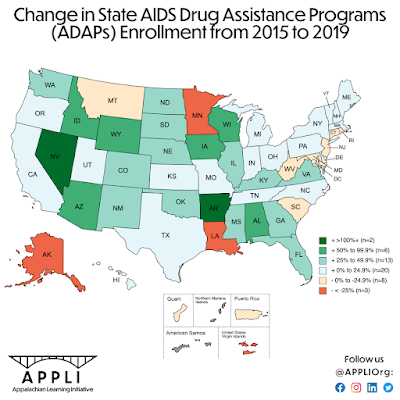
Map showing change in State AIDS Drug Assistance Programs (ADAPs) enrollment 2015-2019
Photo Source: HRSA, 2022

The Demographics of ADAP

77.7% of ADAP clients are male—a figure that has remained unchanged since 2015. Similarly, the racial and ethnic demographics of ADAP clients have remained largely unchanged since 2015, with an average of roughly 40% of enrollees being Black Americans, 26% being Hispanic/Latino, and 30% being White from 2015 to 2019. Of the women who are clients of ADAP, over half (57.0%) are Black. Additionally, ADAP enrollees have continued to overwhelmingly be at the lowest end of the income eligibility scale with 43.5% of clients earning between 0% - 100% of the Federal Poverty Level (FPL)—$12,490/year for an individual.

These demographics have all remained largely unchanged over the past decade in no small part because they are reflective of the HIV epidemic, in and of itself. New HIV diagnoses continue to be disproportionately identified in Black, Brown, and lower-income communities. As a result, those clients compose the majority of ADAP clients.

In addition to gender, race, and income demographics, ADAP clients who are part of a racial or ethnic minority tend to be younger than their White counterparts. 58.6% of White ADAP clients are aged 50 or older.

Health Coverage of ADAP Clients

In 2019, nearly 40% of all ADAP clients had no healthcare coverage, whatsoever, including private and employer-sponsored insurance, Medicaid coverage, Medicare coverage, Veterans Administration coverage, Indian Health Services coverage, and other types of coverage. This varies by race, with just 22.0% of White clients lacking healthcare coverage compared with 49.3% of Hispanic clients and 43.8% of Black clients. It also varies by gender, with 38.5% of male clients lacking coverage and 37.3% for females. Trans folx and gender non-conforming individuals were disproportionately impacted by a lack of healthcare coverage, with 48.3% of transgender male clients, 50.2% of transgender female clients, and 60.4% of clients with different gender identities lacking coverage.

Services Utilization of ADAP Clients

The percentage of clients who received only full-pay medication assistance (where ADAP pays the full cost of medications) decreased from 52.6% in 2015 to 46.8% in 2019. This number is expected to decrease as more ADAP programs begin transitioning clients over to other payor models, such as insurance continuation programs, medication co-pay/deductible assistance, or insurance premium assistance. Each of these models represents cost savings for ADAP programs over the full-pay medication assistance service, as the ADAP programs are no longer paying the full cost of medications.

Breaking these services down by Health and Human Services (HHS) Region (Figure 2), Region 4, which comprises most of the American South, saw the highest percentage of ADAP clients receiving full-pay medication assistance (38.6%).

Figure 2. Map of United States Department of Health and Human Services Regions

United States Department of Health & Human Services Region Map
Photo Source: HRSA, 2022

 Potential Concerns for ADAPs

There are some concerns being circulated that ADAP enrollment may begin increasing in the near future. The onset of the COVID-19 global pandemic resulted in the Secretary of HHS declaring quarterly national Public Health Emergencies (PHEs) beginning in January 2020 (Office of the Assistant Secretary for Preparedness and Response, 2022). One of the provisions of the PHE declarations required states to keep people enrolled in state Medicaid programs throughout the PHE in order to receive the temporary increase in the federal share of Medicaid costs. 

When the Secretary fails to renew the PHE, this provision, along with the increased federal funding, will end, meaning that state Medicaid programs will likely begin redetermining eligibility. This could result in an influx of clients moving off of Medicaid and back onto state ADAP programs, which are statutorily required to be the “payor of last resort.”

Additional concerns exist around the reauthorization of the Ryan White HIV/AIDS Program (RWHAP), which has not been reauthorized since 2009. Because the law has no sunset provision, meaning that it can be funded in perpetuity. There have been consistent concerns about reopening RWHAP for reauthorization for fear that Republicans in Congress will gut the program. These concerns have been voiced since at least 2013. As a result, there is little advocacy in favor of reauthorization.

Ultimately, the ADAP program is currently as “safe” as it’s ever been. Waitlists are virtually a thing of the past, meaning that eligible patients are able to gain access to the medications that they need. The ADAP Advocacy Association will continue to monitor the program for both successes and challenges.

References:

  • Health Resources and Services Administration. (2020, September). Ryan White HIV/AIDS Program AIDS Drug Assistance Program (ADAP) Annual Client-Level Data Report 2019. Rockville, MD: United States Department of Health and Human Services: Health Resources and Services Administration: HIV/AIDS Bureau: Division of Policy and Data https://ryanwhite.hrsa.gov/sites/default/files/ryanwhite/data/hrsa-adr-data-report-2018.pdf
  • Health Resources and Services Administration. (2022, June). Ryan White HIV/AIDS Program AIDS Drug Assistance Program (ADAP) Annual Client-Level Data Report 2019. Rockville, MD: United States Department of Health and Human Services: Health Resources and Services Administration: HIV/AIDS Bureau: Division of Policy and Data https://ryanwhite.hrsa.gov/sites/default/files/ryanwhite/data/hrsa-adr-data-report-2019.pdf
  • Office of the Assistant Secretary for Preparedness and Response. (2022, April 12). Renewal of Determination That A Public Health Emergency Exists. Washington, DC: United States Department of Health and Human Services: Office of the Assistant Secretary for Preparedness and Response: Public Health Emergency Declarations. https://aspr.hhs.gov/legal/PHE/Pages/COVID19-12Apr2022.aspx 

Disclaimer: Guest blogs do not necessarily reflect the views of the ADAP Advocacy Association, but rather they provide a neutral platform whereby the author serves to promote open, honest discussion about public health-related issues and updates.